What tile roof underlayment replacement is
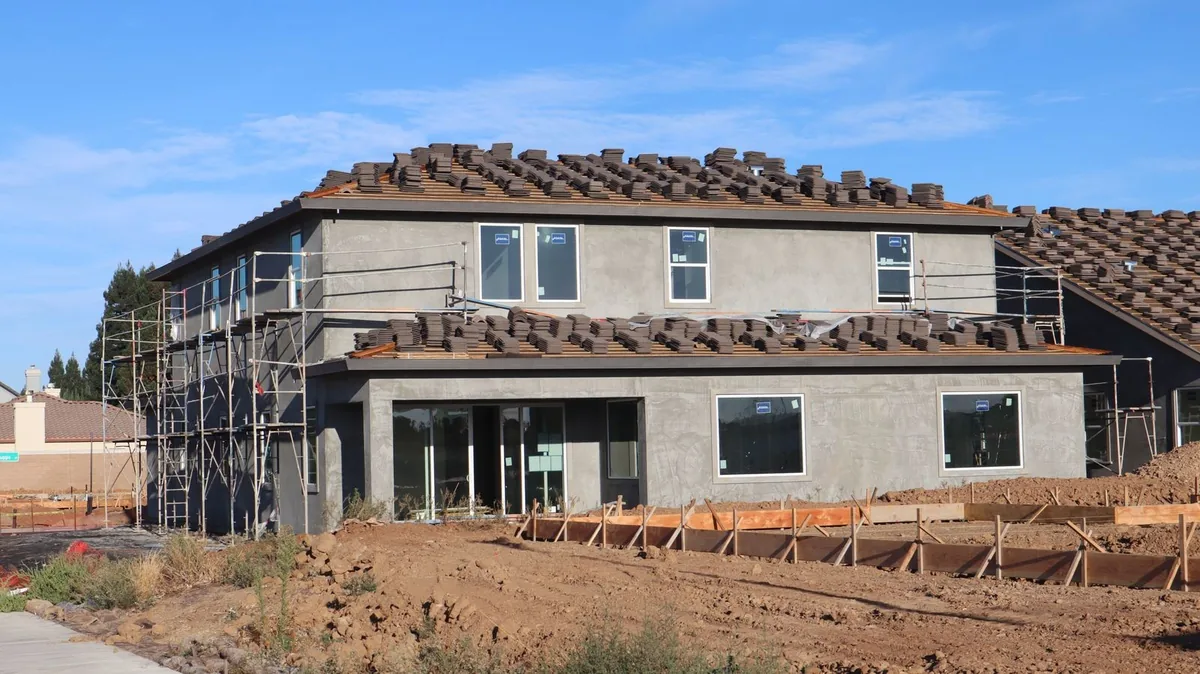
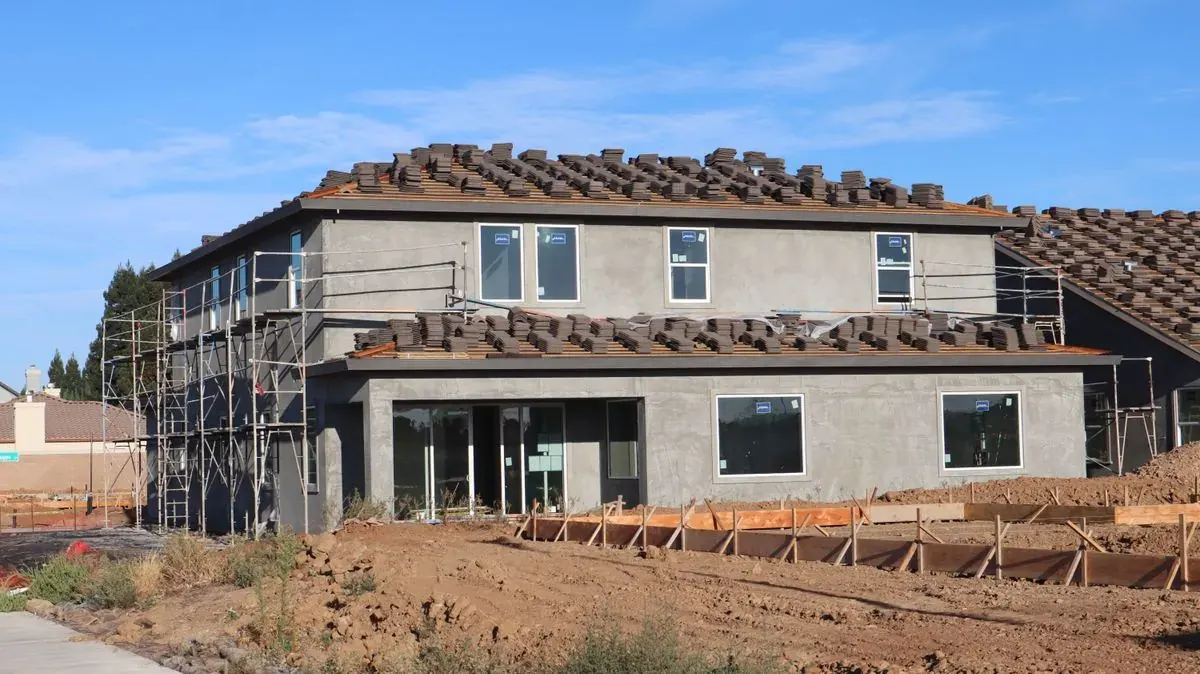
Tile roof underlayment replacement in Buckeye, AZ is the job of lifting your existing concrete or clay tile, replacing the worn-out felt underneath with a new waterproof underlayment and new flashings, and relaying the same tile. Roofers also call it a re-felt, a tile reset, a tile-over or a lift and relay. It exists because the two layers of a tile roof wear out on completely different schedules.
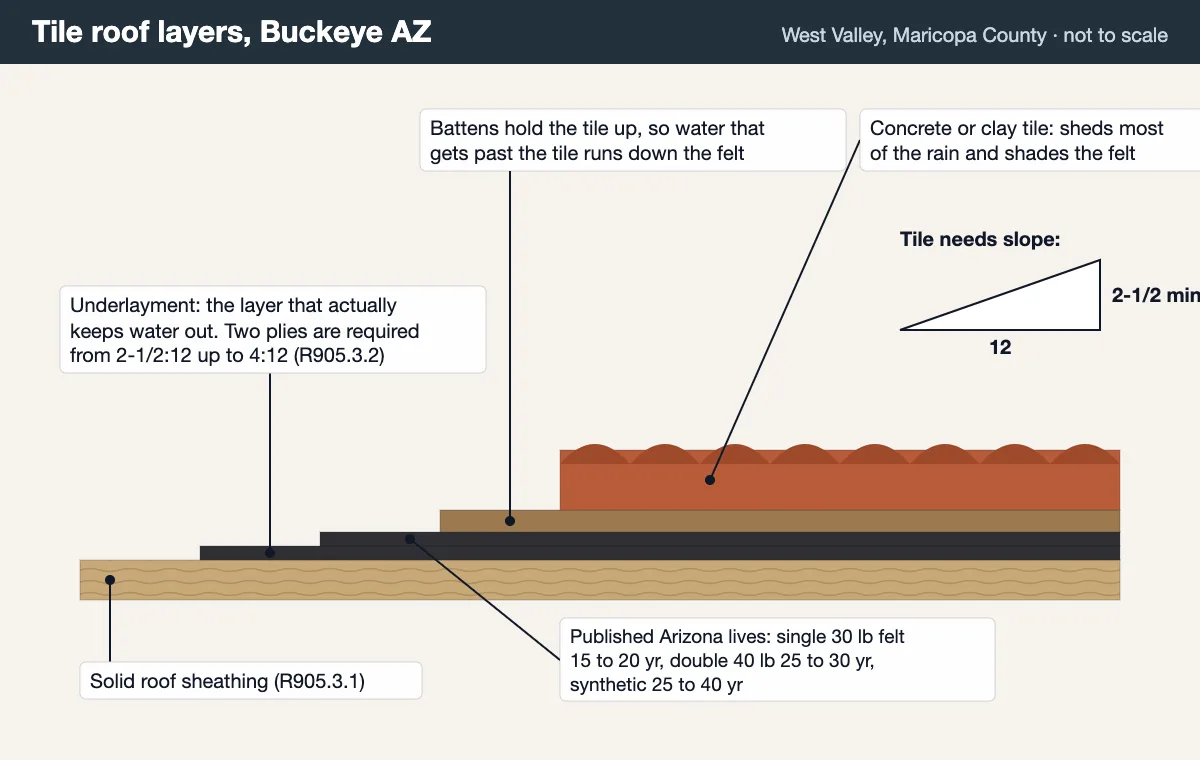
The tile sheds most rain and shades what is under it. The underlayment is the actual waterproof membrane, and it lives in brutal conditions: under dark tile, on a deck that cooks every summer afternoon. An Arizona roofing guide notes that the same materials that last 30 years or more in milder climates "often last only 20-25 years here". The tile above the felt, meanwhile, is commonly reused when the felt is replaced.
That gap is why a leaking tile roof in Buckeye is so often a puzzle to its owner. Nothing looks broken. The tile is intact, the color is fine, and water is still coming through. It is the felt.

Why Buckeye has so many failing underlayments right now
Buckeye has an underlayment wave because its tile roofs were built in a wave. The city grew from 6,537 residents in 2000 to 50,876 in 2010, and the master-planned communities that carried that growth were built on concrete tile: Sundance from 2002, Verrado from 2004, Tartesso with about 3,000 lots completed in the 2005 boom, Sun City Festival from 2006.
The paper under most of those roofs was single-layer 30-pound felt, which a Phoenix roofer's published table describes as "common on homes built before 2005" with an Arizona service life of 15 to 20 years. A 2004 Verrado roof with original felt is 22 years old in 2026. A 2006 Sun City Festival roof is 20.
Signs the underlayment under your tile has failed
The surest sign of failed underlayment is a leak that appears after rain on a tile roof with no visible broken tile. These are the others a homeowner can check, most of them without climbing onto the roof.
- Ceiling or wall stains that appear after the first monsoon storms, in rooms where nothing on the roof looks wrong
- Black, brittle or cracked felt visible at the eaves, at the bottom edge of the roof, or in a gap where a tile has slipped
- Felt that tears or crumbles to the touch when a roofer lifts a tile
- Water staining on the underside of the deck or along rafters in the attic, rather than one clean drip point
- Several separate leaks over one or two seasons, which points at the whole sheet rather than one hole
- A home finished between 2002 and 2008 still on its original felt
- Tile that has been walked on by solar, satellite or HVAC installers, which often tears the aged felt beneath
Tile roof underlayment replacement cost in Buckeye
Tile roof underlayment replacement on a typical 2,000 square foot Buckeye roof costs about $7,000 to $10,000 according to published Phoenix-area figures, and $9,000 to $17,000 under a broader 2026 Arizona per-square-foot band. Both sources agree on the key point: it costs far less than a new tile system, which the 2026 guide puts at $14,000 to $28,000 on the same roof.
| Roof size | Typical cost range | Notes from the source |
|---|---|---|
| 1,500 sq ft | $5,000 to $7,000 | Smaller single-story homes |
| 2,000 sq ft | $7,000 to $10,000 | Standard home |
| 3,000+ sq ft | $10,000 to $15,000+ | Larger or complex rooflines |
Source: a Phoenix roofing contractor's published tile underlayment guide. A May 2026 Arizona cost guide puts a tile-over with existing tile reused at $4.50 to $8.50 per square foot ($9,000 to $17,000 on 2,000 sq ft) against $7.00 to $14.00 ($14,000 to $28,000) for a full new concrete tile system.
What changes the price
The price moves with the roof's size and pitch, the number of valleys, hips and walls that need new metal, the underlayment grade chosen, the amount of deck repair found once the felt is off, the tile breakage allowance and whether solar has to be detached and reset. The full worked breakdown is in the underlayment replacement cost guide.

Choosing the new underlayment
The underlayment you choose decides whether this is the last time the roof needs this job. The labor to lift and relay the tile is essentially the same whichever sheet goes underneath, so the extra cost of a better product buys years of service at a low marginal price.
| Underlayment | Arizona lifespan | Where it fits |
|---|---|---|
| 30# felt, single layer | 15 to 20 years | The original spec on many 2000s homes; not recommended for a re-felt |
| 40# felt, double layer | 25 to 30 years | Mid-grade tile roofs |
| G40 / modified bitumen | 25 to 35 years | Handles daily expansion and contraction |
| Synthetic | 25 to 40 years | Lightweight, tear-resistant, stable in heat |
| Peel-and-stick / rubberized | 30 to 40 years | Premium; excellent in valleys and transitions |
Source: a Phoenix roofer's published Arizona underlayment table. Another Arizona guide notes some high-temperature rubberized underlayments are rated to resist heat of up to 250°F.
How the job is done
A tile roof underlayment replacement runs in six steps, and the critical one is the fourth, when the deck is exposed and can be inspected and repaired across the whole roof.
- Confirm the felt has failed. A roofer lifts tiles on several slopes, always including the south and west faces, to see the felt. Brittle, cracked, sun-baked or missing felt across the roof confirms an underlayment job rather than a spot repair.
- Plan the tile. The roofer counts the tile profile and condition, estimates handling breakage, and identifies a source for matching replacements or decides which slopes will donate tile to the front elevations.
- Lift and stack. Tile is removed slope by slope and stacked on the roof, spreading the weight rather than piling it, so it does not have to be lowered to the ground and carried back up.
- Strip, inspect and repair the deck. Old felt, battens and worn flashings come off down to the sheathing. Damaged sheathing is replaced and the deck is checked across the whole roof while it is visible.
- New underlayment and metal. New underlayment goes down, with new valley metal, drip edge, wall and step flashings, pipe and vent flashings and new battens where the tile system uses them.
- Relay the tile. The original tile is relaid in courses, broken pieces are replaced with matched tile, and the ridges and hips are bedded and fastened. Rooftop solar is reset with new flashed attachments.
Re-felt, repair or full new tile roof?
The right job depends on two things: the condition of the felt across the whole roof, and the condition of the tile itself.
When a repair is enough
A tile roof repair is right when the roof is young, the felt is sound when lifted elsewhere, and the leak traces to one cause: a cracked tile, a slipped piece after a downburst, a failed pipe flashing.
When underlayment replacement is right
Underlayment replacement is right when the felt has failed across the roof and the tile is still sound, which is the situation on most 2000s Buckeye homes. As a Phoenix guide puts it, when the underlayment is more than 15 to 20 years old, spot repairs "are usually a short-term solution at best."
When a full new tile roof is the better buy
A full roof replacement is the better buy when a large share of the tile is breaking or eroded, when the profile can no longer be matched, or when the HOA is pushing a color or profile change anyway.
HOAs, permits and solar

Relaying the same tile over new underlayment is about as uncontroversial as roofing gets for an HOA, because the finished roof looks exactly as it did. Communities such as Verrado and Sun City Festival still have architectural review processes, so it is worth notifying the association before the crew arrives.
On permits, Buckeye's amendment to section 105.2 exempts residential re-roofing "with the same type of material as the original roofing", which describes a re-felt. See the permit guide for the cases that are not exempt.
Solar panels have to come off for this job. That is also an opportunity: the racking attachments, a common source of tile roof leaks, are reflashed into the new underlayment rather than left as they were. See solar panel removal and reinstall, the service area, or request a quote.