The short answer
Buckeye's adopted building code exempts re-roofing a house with the same type of material from a building permit, and requires one for a change of roofing material, structural work and commercial re-roofs. But the City's own Permit Center page lists re-roofs among the projects that require permits, so the honest short answer is: the code says a like-for-like residential re-roof is exempt, and the Permit Center is the place to confirm it for your job.
What the City's Permit Center says
The City's Permit Center page takes a broader line than the code amendment. It says permits are required to construct, repair, improve or demolish buildings and structures within Buckeye city limits, and that permits are "also required, but not limited to fencing, pools, spas, patios, solar and re-roofs", asking anyone in doubt to contact the Permit Center for clarification.
Read together, the safe approach is clear: the adopted code exempts a like-for-like residential re-roof, the Permit Center lists re-roofs as permit work, and the Permit Center is the office that decides for your address. A roofer working through this site checks with the Permit Center rather than assuming either way.
City of Buckeye Permit Center →
Reading the exemption closely
The exemption has three conditions, and a job has to meet all of them.
1. Residential (R3)
R3 is the building code occupancy for one- and two-family homes. Commercial buildings, apartment blocks, HOA clubhouses and other non-R3 buildings are outside the exemption.
2. The same type of material
Tile to tile, shingle to shingle, foam to foam. A tile underlayment replacement that relays the same tile fits. A change from shingle to tile, tile to foam, or shingle to metal does not.
3. No more than one shingle layer over shingle
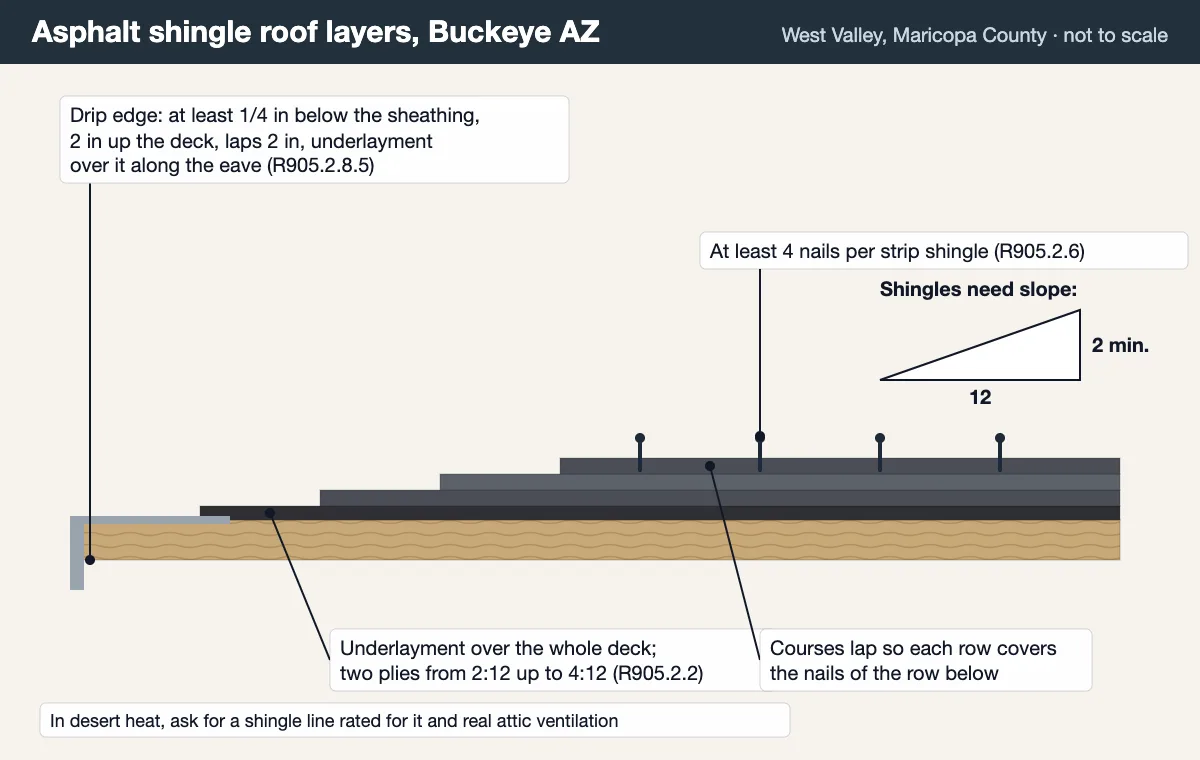
An overlay of one new asphalt shingle layer on an existing shingle roof is within the exemption; a second overlay is not. Tile is never laid over tile.
| Job | Inside the residential exemption? |
|---|---|
| Tile re-felt relaying the same tile on a house | Yes |
| Shingle tear-off and new shingle on a house | Yes |
| One layer of shingle over existing shingle | Yes |
| Foam roof recoat or foam-to-foam re-roof on a house | Yes (a recoat is maintenance) |
| Shingle to tile, tile to foam, or any material change | No: permit needed |
| Structural rafter or framing replacement | No: permit needed |
| Commercial or multi-family re-roof | No: permit needed |
| Property in unincorporated Tonopah, Palo Verde or Arlington | City rules do not apply: check with Maricopa County |
Summary for orientation only. The City of Buckeye Development Services department is the authority for any specific project.
Changing the roofing material
A change of material is the most common reason a residential re-roof in Buckeye needs a permit. Beyond the paperwork, it can have real engineering consequences.
- Shingle to tile: tile is far heavier, so the framing must be checked for the load
- Tile to metal or shingle: lighter, but flashing, ventilation and edge details change
- Pitched roof sections to foam: only suitable on low-slope areas
- Any change in a community with architectural standards also needs HOA approval
HOA approval: a separate step
A City permit and HOA approval answer different questions. The City cares about building codes; an HOA cares about how the community looks. Most of Buckeye's master-planned communities, including Verrado, run by the Verrado Community Association, and Sun City Festival, have architectural standards covering roofs.
Outside City limits: Maricopa County
Not every Buckeye-area address is inside the City. Tonopah, Palo Verde, Arlington and other unincorporated places are regulated by Maricopa County Planning and Development, which oversees development activity in the unincorporated areas of the county. The City's re-roof exemption does not apply there.
Maricopa County Planning and Development →
Licensing is not optional
Whether or not a permit is needed, roofing in Arizona is licensed work. A.R.S. 32-1151 makes it unlawful to act or offer to act as a contractor without a license, and A.R.S. 32-1124 requires the license number, preceded by "ROC", on all written bids and estimates.
A.R.S. 32-1124 on the Arizona Legislature website → See also how to check a roofer's license.
Solar and permits
Solar is electrical work with its own requirements. Buckeye's residential code amendments state that residential photovoltaic systems are installed per the 2023 National Electrical Code as adopted by the City. In unincorporated Maricopa County, the County offers SolarAPP+ for eligible residential rooftop solar permits. See solar panel removal and reinstall, roof replacement, or ask a licensed roofer.
Who applies for the permit
When a roofing job needs a permit, the licensed roofer normally applies for it as part of the job. Your quote should say so in writing, along with whether the permit fee is included. If a roofer suggests you pull the permit yourself as the owner, ask why: it can shift responsibility for the work onto you.
- The quote says whether a permit is needed, and who confirms it with the City or County
- The quote says who applies and whether the fee is included
- HOA approval is listed as a separate step with its own timing
- Inspections are scheduled by the roofer, and you get a copy of the final sign-off
What permits cost in the Phoenix area
Published Phoenix-area figures give a sense of scale. A 2026 Arizona price guide says to add $150 to $650 for a reroof permit depending on jurisdiction, and another Phoenix-area roofer puts Phoenix residential re-roof permits at $250 to $400. For Buckeye's current fee, ask the Permit Center or your roofer.
| Source | Figure |
|---|---|
| Arizona roofing price guide, 2026 | $150 to $650 depending on jurisdiction |
| Phoenix-area roofer's cost page | $250 to $400 for Phoenix residential re-roofs |
Reference figures for the region, not Buckeye's fee schedule.
Commercial re-roofs
Buckeye's re-roof exemption amendment is written for residential (R3) buildings. Warehouses, retail, offices, churches, schools and HOA amenity buildings are not R3, so the exemption does not reach them. Treat a commercial re-roof as permit work unless the City confirms otherwise, and expect the roofer to hold a C-42 or CR-42 license.
See commercial roofing in Buckeye.
Why getting it right matters
A permit brings an inspection, which is a second set of eyes on work you cannot see once the tile is back down. Work that needed a permit and did not get one can also surface later: when you sell, when an insurer asks about the roof, or when the City reviews a future project at the same address. Confirming first takes a few minutes and avoids all of that.
Repairs versus re-roofs
Small repairs, such as resetting slipped tile, replacing a few broken tiles or resealing a flashing, are a different scale of work from a re-roof. Where a repair grows into replacing the underlayment on a whole slope or changing material, ask the roofer to confirm with the City whether it now counts as permit work. See roof repair in Buckeye.
Permit and HOA: the order of operations
In Buckeye's master-planned communities, many roof jobs need both an HOA approval and a decision on the permit. They are separate, and doing them in the right order avoids delays.
| Step | Who | Notes |
|---|---|---|
| Inspection and quote | Roofer | Scope, materials and colors defined |
| HOA application | Owner, with the roofer's specs | Material, color and sometimes a sample |
| Permit question | Roofer, with the City or County | Confirm with the Permit Center; apply if needed |
| Scheduling | Roofer | After both approvals; ideally before June 15 |
| Inspections and sign-off | Roofer and City or County | Keep a copy of the final sign-off |
Keep the HOA approval letter and any permit sign-off with your house documents. Both are useful when you sell.
Sources for this guide
- City of Buckeye adopted building codes and amendments, including the IBC 105.2 re-roof exemption
- City of Buckeye Permit Center guidance listing re-roofs among projects requiring permits
- Maricopa County Planning and Development, including its residential solar permit guidance
- A 2026 Arizona roofing price guide and a Phoenix-area roofer's cost page, for permit fee ranges
- A.R.S. 32-1151, on licensing
Permit terms
| Term | Meaning |
|---|---|
| R3 | The building code occupancy group for one- and two-family homes |
| IBC / IRC | International Building Code / International Residential Code, adopted by Buckeye in their 2024 editions |
| Exemption | Work the adopted code says does not need a permit |
| Unincorporated | Land outside any city, governed here by Maricopa County |
How to work out whether you need a permit
- Find out who has jurisdiction. Inside Buckeye city limits, the City; on unincorporated parcels, Maricopa County.
- Describe the job precisely. Same material or a change? House or commercial? Any structural work?
- Check the exemption. Like-for-like residential re-roofing is exempt under the City's IBC 105.2 amendment.
- Confirm with Development Services. If anything is unclear, confirm with the City before work starts.
- Get HOA approval separately. Architectural review is its own step in most master-planned communities.