Flat roofs in Buckeye
Flat roof repair in Buckeye, AZ covers more roofs than people expect. Besides commercial buildings, many homes have a flat or low-slope section: a patio cover, an addition, a casita, a garage, or the flat roof of a Pueblo-style or older ranch home. Those sections are usually spray foam with a reflective coating, sometimes modified bitumen, TPO or an older built-up roof.
Flat roofs fail differently from pitched ones. Water does not run off quickly, so it finds small defects; rooftop equipment cuts holes through the roof; and Arizona sun, with roof surfaces that can pass 160 degrees, works constantly on coatings and membranes. Dust from monsoon storms blocks the drains just when the rain arrives.
The good news is that most flat roof problems are repairable if they are found while they are small. The key is knowing whether the roof underneath is still dry.
Flat roof types and their typical problems
| System | Installed cost per sq ft | Typical problems |
|---|---|---|
| Spray foam (SPF) with coating | $3.50 to $7.00 | Coating wear-through, blisters, bird damage, ponding |
| Modified bitumen | $4.00 to $8.00 | Seam separation, surface cracking, blistering |
| TPO single-ply | $5.00 to $10.00 | Seam and flashing failures, punctures |
| Built-up roof (BUR) | $5.00 to $8.00 (Phoenix-area guide) | Cracking, blistering, gravel loss, age |
Cost sources: Arizona roof replacement cost guide, May 2026 (SPF, mod bit, TPO); Phoenix-area roof replacement cost guide (BUR).
Spray foam
Foam is the most common flat roof in Buckeye and it fails through its coating. Once the coating wears through, sun breaks down the foam and water gets in. See foam roofing.
Modified bitumen and built-up
These asphalt-based systems crack and blister with age and heat, and their seams and laps separate. Repairs are torched or adhered patches and renewed flashings.
TPO
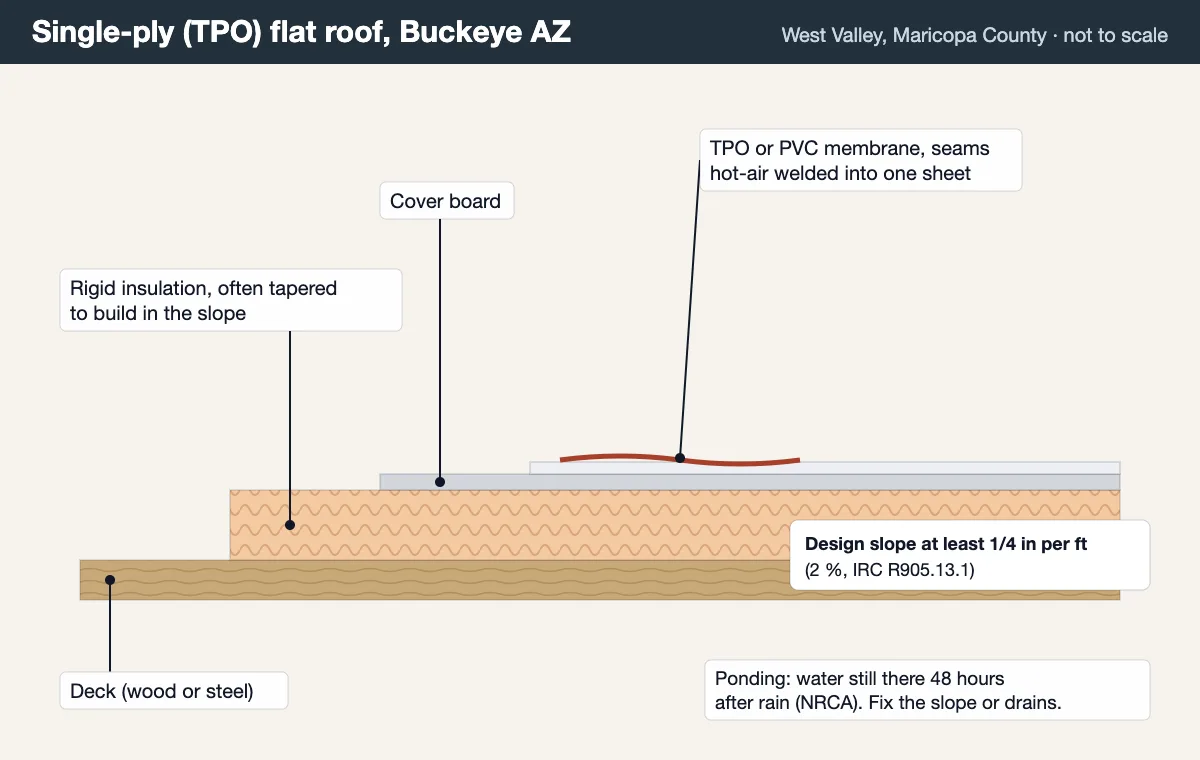
TPO is a white single-ply membrane with heat-welded seams. Its weak points are seams, perimeter flashings and punctures. See TPO roofing.
Signs your flat roof needs repair
- Water sitting more than a day or two after rain
- Blisters, bubbles or soft spots underfoot
- Coating worn through, chalking, or cracked
- Seams lifting or separating, especially at edges
- Cracked or pulled-away flashing at walls, curbs and parapets
- Stains on ceilings under a patio cover or addition
- Debris and dust packed into scuppers and drains
Patio covers and the flat-to-pitched joint
On homes, the most common flat roof leak in Buckeye is where a flat patio cover or addition meets the main pitched roof or the house wall. Water running off the tile lands right on that joint in every storm, and the flashing and coating there take more abuse than anywhere else on the flat section.
Repairs here mean renewing the flashing properly, building up the coating, and sometimes improving the slope so water moves away from the wall instead of sitting against it.
Rooftop equipment
Air conditioners, evaporative coolers and package units on flat roofs are the leading cause of flat roof leaks, on homes and on commercial buildings. Each one sits on a curb or stand, with lines and ducts passing through the roof, and is serviced by technicians who walk across the roof to reach it.
Repair, recoat or replace?
Whether a flat roof is repaired, recoated or replaced depends mostly on moisture. A dry roof with surface damage can be repaired and recoated, often for decades. A roof that is wet over large areas has to come off, because coatings and patches over wet material trap water.
See roof coating, commercial roof repair, roof replacement, the service area, or request a flat roof repair quote.
Older built-up roofs
Some older buildings in and around downtown Buckeye still have built-up roofs: layers of felt and asphalt, often with a gravel surface. A Phoenix-area guide puts built-up roofing at $5.00 to $8.00 per square foot installed. These roofs crack and blister with age, lose gravel in wind, and develop wet areas that are hard to see from the surface. Repairs are possible, but an aging BUR is often a candidate for replacement with foam or a membrane.
Dealing with ponding
Ponding is the slow killer of flat roofs. Water that sits for days after monsoon rain breaks down coatings, stresses seams and feeds any leak. The fixes, in rough order of cost:
- Clear blocked drains, scuppers and downspouts
- Add or enlarge scuppers or drains where water has no exit
- Build up low areas with foam during a repair or recoat
- Install tapered insulation to create slope during a replacement
- Choose a coating suited to ponding where it cannot be eliminated
Roof-to-wall and parapet details on homes
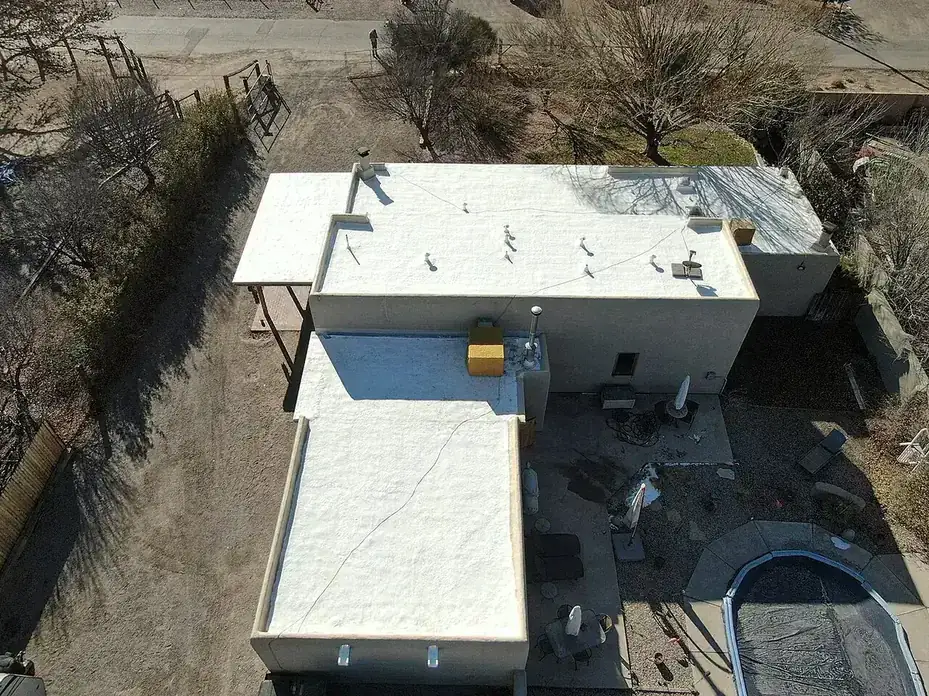
Flat roofs on homes, especially Pueblo-style and contemporary designs, are often surrounded by short parapet walls finished in stucco. The roof turns up the inside of those walls, and water drains out through scuppers. Leaks here come from cracked stucco on the parapet top, failed flashing where the roof meets the wall, and scuppers that are blocked or poorly sealed.
Because water entering at a parapet can run down inside the wall, these leaks often show up on interior walls rather than ceilings. Repairs combine roofing work with the stucco and flashing at the wall top.
How a flat roof is repaired
- Inspect and moisture-check. The roofer walks the roof, checks seams, flashings, drains and coatings, and probes or moisture-tests suspect areas.
- Clear drainage. Scuppers, drains and gutters are cleared, and ponding areas noted for correction.
- Cut out damage. Wet foam, split blisters, failed membrane and deteriorated flashings are removed back to sound material.
- Repair with compatible materials. Foam is refilled, membranes patched or rewelded, mod bit torched or adhered, and flashings at curbs and penetrations renewed.
- Protect the surface. Coatings are renewed where needed so the repaired area is protected from UV like the rest of the roof.