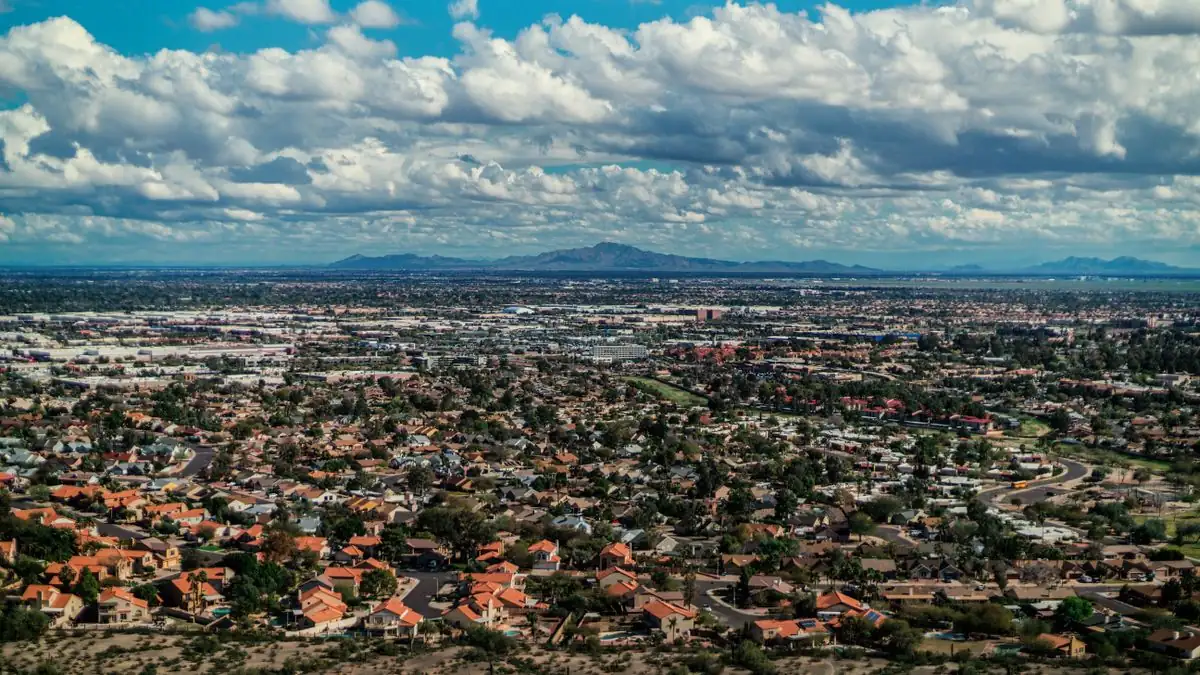
Roofing in Buckeye, AZ
Tile underlayment replacement, roof repair, monsoon storm damage, full re-roofs, foam and coatings, and commercial roofs, quoted in writing by a licensed Arizona roofer. For every community in Buckeye, from Verrado and Sun City Festival to Tartesso, Sundance and the historic downtown.
- Tile underlayment replacement
- Leak and monsoon repair
- Tile, shingle, foam and metal
- Commercial and warehouse roofs
Why roofing in Buckeye, AZ is its own job
The short answer: most Buckeye homes built after 2000 have concrete tile over felt, and the single-layer 30-pound felt most Valley homes built before about 2005 received has a published Arizona life of 15 to 20 years, so the most common job here is an underlayment replacement that reuses the tile ($7,000 to $10,000 for a 2,000 square foot roof in published Phoenix-area figures) rather than a new tile roof ($14,000 to $28,000). Every quote comes in writing from an ROC-licensed Arizona roofer.
Roofing in Buckeye, AZ comes down to three local facts: a housing stock built in a few fast waves, a summer that is getting hotter, and a monsoon that arrives every year on schedule. Each one changes what a roofer should be looking for on your roof.
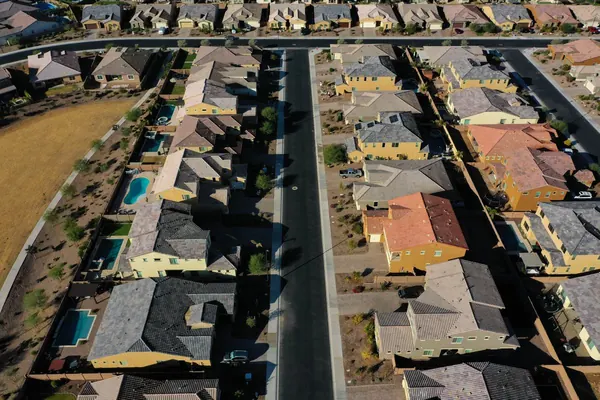
The housing first. Buckeye had 6,537 residents in 2000, 50,876 in 2010 and 91,502 in 2020, and the Census Bureau's July 2024 estimate is 114,334. The master-planned communities that carried that growth started building early in the 2000s: Sundance from 2002, Verrado from 2004, Tartesso with about 3,000 lots in the 2005 boom, and Sun City Festival from 2006. Almost all of them went up in concrete tile over felt. Published Arizona service lives put single-layer 30-pound felt at 15 to 20 years, which means thousands of Buckeye roofs are reaching the end of their underlayment together.
Then the weather. 2024 brought Phoenix a record 113 consecutive days at or above 100 degrees, beating the previous record of 76 days set in 1993, plus a record count of 110-degree days. Roof surfaces in that sun can pass 160 degrees, which is what breaks down felt, shingle and foam coatings. And every year from June 15 to September 30 the monsoon brings downbursts above 60 mph, dust storms and the occasional hail. The roofs that fail in August are usually the ones that were already tired in May.
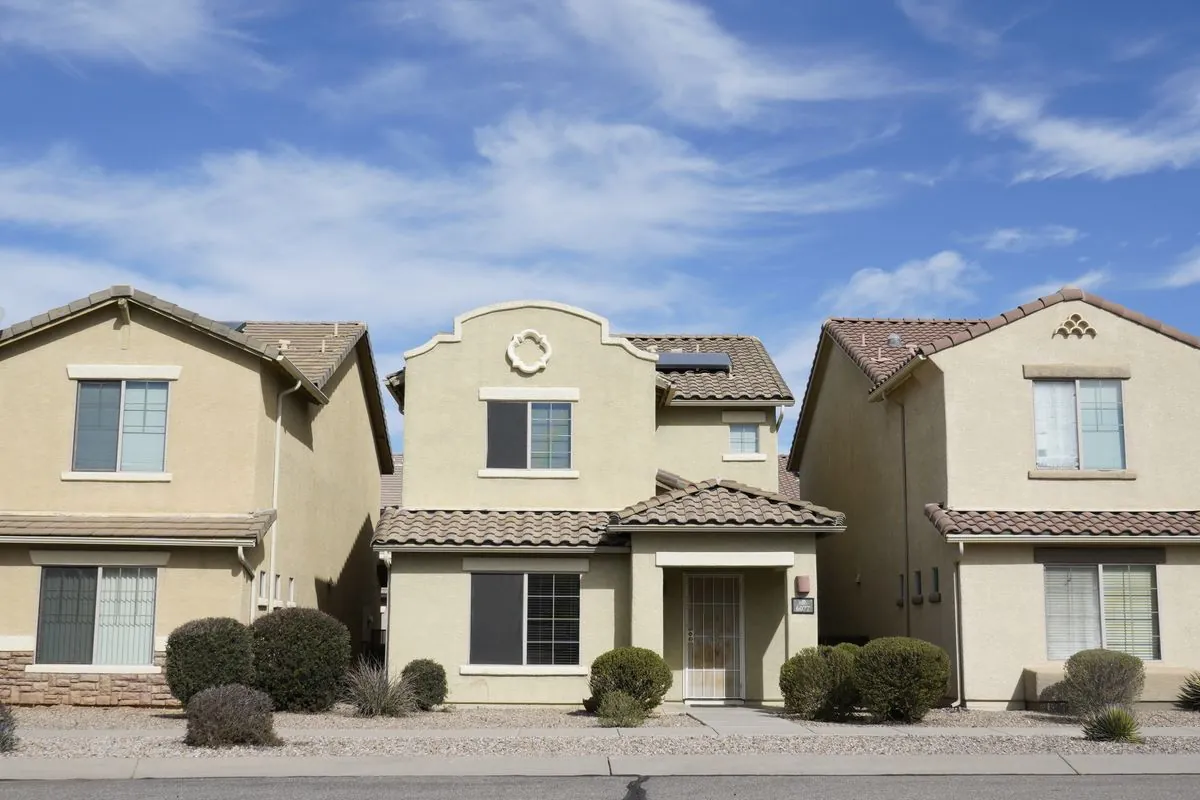
Roofing services in Buckeye, AZ
These three are the jobs most Buckeye homeowners actually call about. Behind them sit seventeen more, each with its own page, from tile and foam repair to TPO on a warehouse, because a slipped tile in Sundance and a 200,000 square foot logistics roof off I-10 share a trade and very little else.
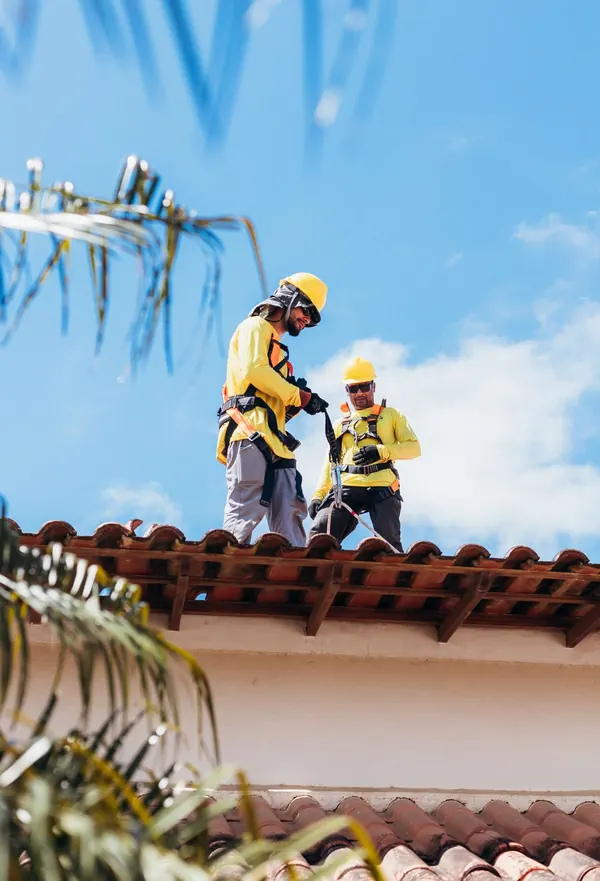
The tile roof problem Buckeye is facing now
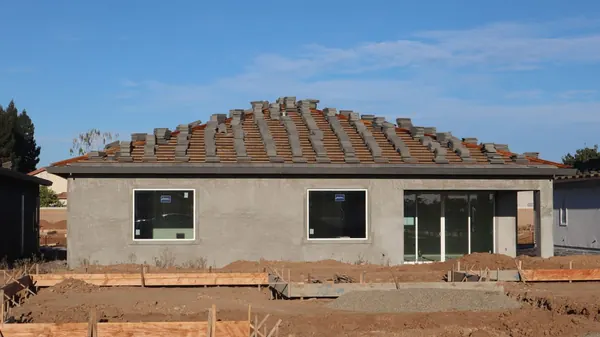
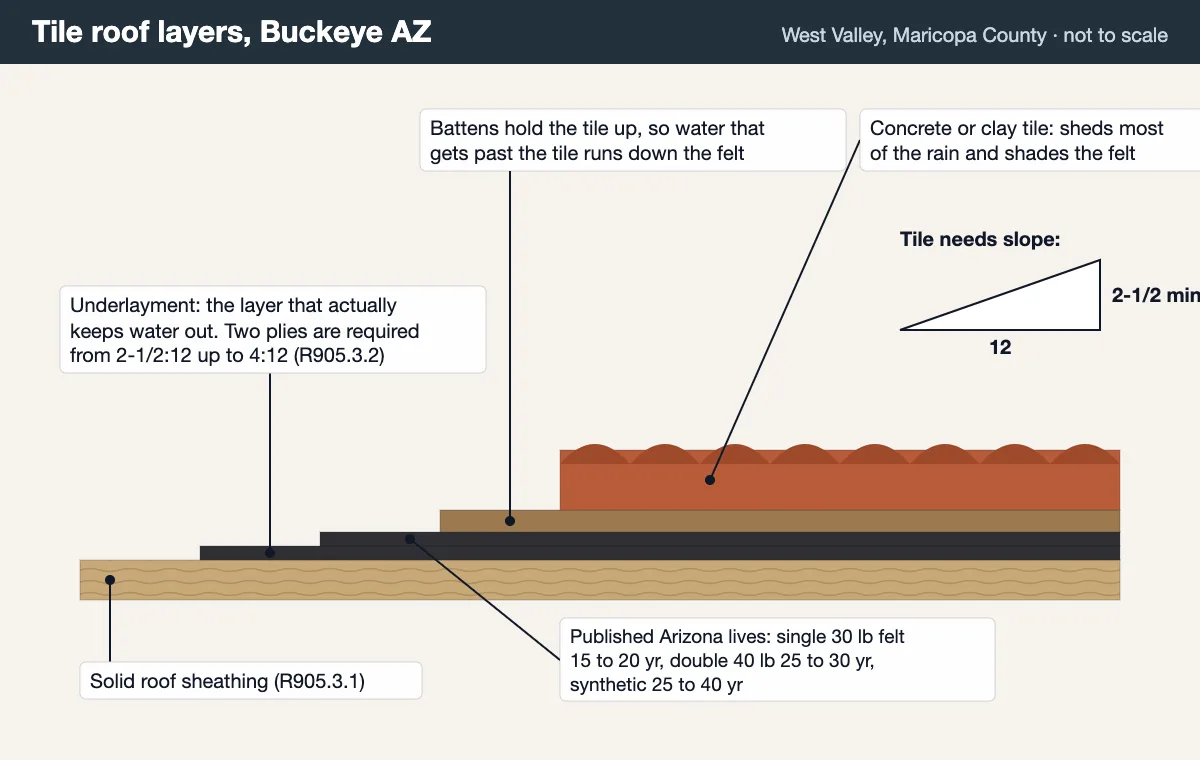
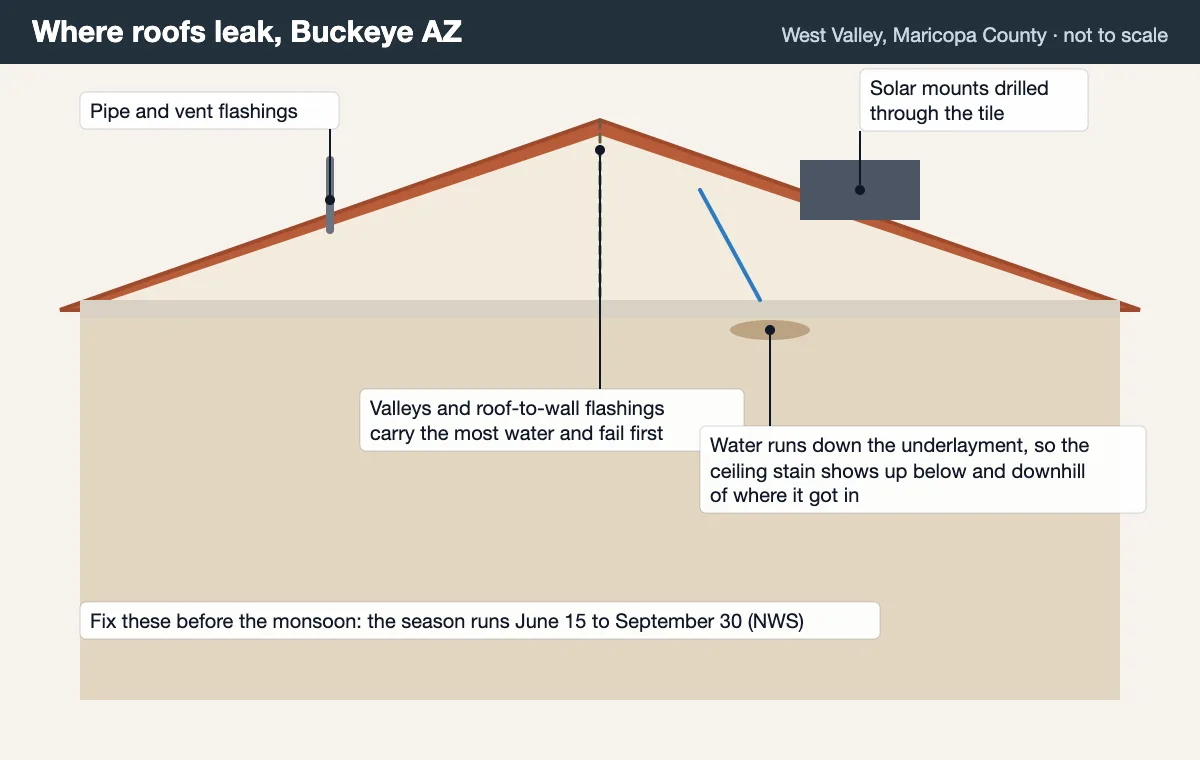
A tile roof leaks through its underlayment, not its tile. Concrete and clay tile shed most of the water and shade the layer beneath, but the felt or synthetic sheet under the tile is the waterproofing, and in Arizona heat it ages much faster than the tile above it.
A Phoenix roofer's published Arizona table puts single-layer 30-pound felt, "common on homes built before 2005", at 15 to 20 years, double 40-pound felt at 25 to 30, synthetic underlayment at 25 to 40 and peel-and-stick at 30 to 40. Another Arizona guide puts ordinary felt at about 12 to 20 years. The arithmetic for a Buckeye house finished between 2002 and 2008 is simple.
The fix is usually not a new roof. An underlayment replacement lifts the existing tile, replaces the felt, flashings and battens, and relays the sound tile. Published Phoenix-area figures put it at $7,000 to $10,000 for a 2,000 square foot roof.
Underlayment cost guide →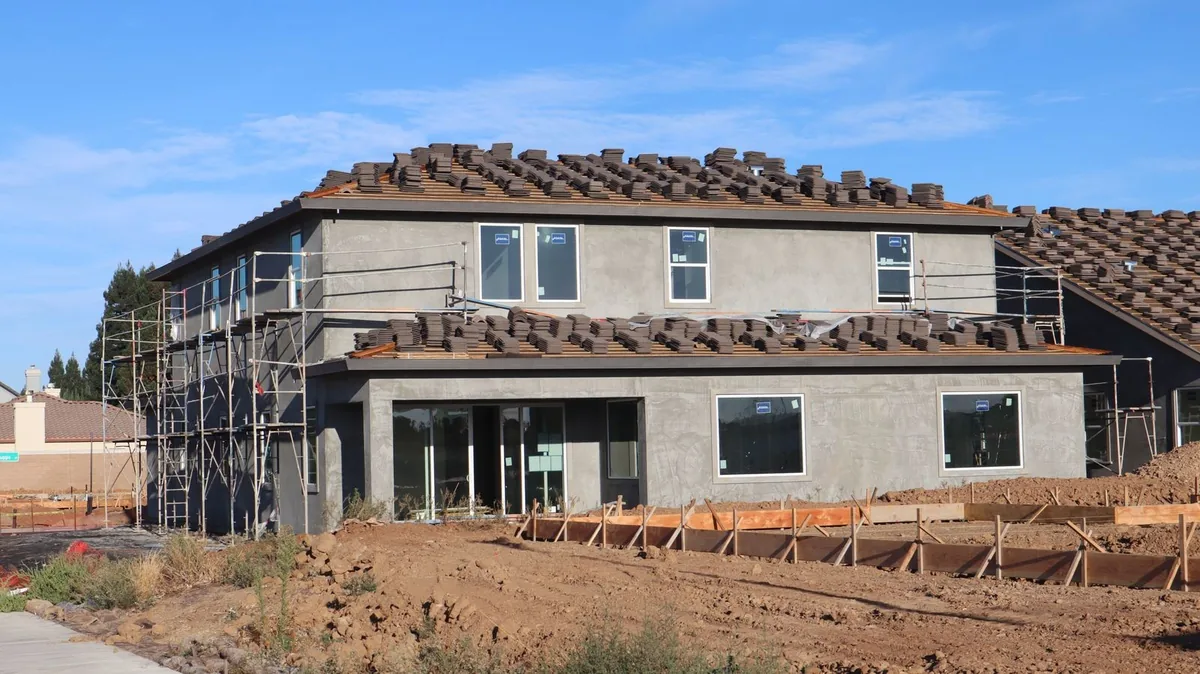
Signs your Buckeye roof needs a roofer
Most of these are visible from the ground or the attic. Any one of them is worth a free inspection before the next monsoon, not after it.
- A ceiling stain that appears after the first monsoon storm of the season, even though the tile above it looks perfect
- Tiles that have slipped down the slope, cracked, or blown loose along the eaves and ridges after a downburst
- Black, brittle felt showing at the eaves or in the gaps where a tile has slipped, which means the underlayment is past its life
- A tile roof on a house built between 2002 and 2008 that has never had the underlayment checked
- Foam roof coating that has chalked, worn through to tan foam, or developed blisters and bird-pecked holes
- Asphalt shingles shedding granules into the gutters or curling at the edges after a few West Valley summers
- Water ponding on a flat roof for more than a day or two after rain
- Lifted flashing around a chimney, wall, skylight or solar mount, or rust lines below a roof vent
The four roof types on Buckeye homes
Almost every roof in Buckeye is one of these four. They fail in different ways, so the first thing a roofer should tell you is which one you have and what is actually wrong with it.
What a roof costs in Buckeye, AZ
A new roof in Buckeye usually costs between $9,000 and $28,000, and the material decides where in that range you land. These are the published 2026 Arizona figures per square foot installed, with the total for a 2,000 square foot roof. Metro Phoenix shares crews, suppliers and wage rates, so the West Valley sits on the same bands; the published Avondale range, the closest city listed, is $11,100 to $23,300.
| Roof system | Per sq ft installed | 2,000 sq ft roof |
|---|---|---|
| Spray foam (flat and low-slope) | $3.50 to $7.00 | $7,000 to $14,000 |
| Architectural asphalt shingle | $4.50 to $7.00 | $9,000 to $14,000 |
| Tile underlayment replacement, tile reused | $4.50 to $8.50 | $9,000 to $17,000 |
| Modified bitumen (flat) | $4.00 to $8.00 | $8,000 to $16,000 |
| TPO membrane (flat) | $5.00 to $10.00 | $10,000 to $20,000 |
| Concrete tile, full new system | $7.00 to $14.00 | $14,000 to $28,000 |
| Metal, panel to standing seam | $8.00 to $18.00 | $16,000 to $36,000 |
| Clay tile, full new system | $10.00 to $18.00 | $20,000 to $36,000 |
Source: Arizona roof replacement cost guide published May 2026 by an Arizona roofing site. The same guide adds $150 to $650 for a re-roof permit where one is required. Your written quote is the only number that counts.
The big swing factors on a Buckeye roof are whether the tile can be reused, how much decking is damaged under it, how many valleys, walls and penetrations need new flashing, whether solar has to come off, and whether an HOA requires a specific tile profile and color. The full breakdown is in the Buckeye roof replacement cost guide.
Commercial roofing in Buckeye, AZ
Commercial roofing in Buckeye is low-slope roofing, and there is a lot more of it every year. The 145-acre Buckeye I-10 Logistics park, the largest industrial complex under development on the city's I-10 frontage just west of Verrado Way, is planned for more than 2.2 million square feet of industrial space, and Amazon has signed a 1.2 million square foot industrial lease in Buckeye.
The roofs on those buildings, and on the retail, office, school and HOA buildings around them, are TPO, spray foam, modified bitumen and metal, and their biggest risk is the rooftop equipment cut through them. Commercial work goes to roofers with the C-42 or CR-42 classification.
How a roofing job runs in Buckeye
A roofing job in Buckeye runs in seven stages, and the one that decides how long the roof lasts is the fifth, when the deck and underlayment are exposed. Ask about that stage on every quote.
- 1Tell us about the roof
The four-field form asks for your name, a number, the property location in Buckeye and what you need. That is enough for a licensed roofer to know whether to bring a ladder for a tile repair, a moisture meter for a foam roof, or a full crew for an inspection ahead of a replacement.
- 2A licensed roofer inspects the roof
The roofer gets on the roof and into the attic where it can be reached. On tile that means lifting a few pieces to see the underlayment, because the felt is what fails. On foam it means checking the coating thickness and looking for blisters and bird damage. On shingle it means checking granule loss, lifted tabs and the flashings.
- 3Written, itemized quote with the ROC number
You get a written quote that separates tear-off, underlayment, flashing, material, disposal and any permit, with the roofer's Arizona ROC license number printed on it as A.R.S. 32-1124 requires. Repair and replacement options are priced side by side when both are honest options.
- 4Permit and HOA paperwork, where needed
Buckeye's amendment to IBC section 105.2 lists like-for-like residential re-roofing as exempt work, while the City's Permit Center lists re-roofs among projects needing permits, so the roofer confirms with the Permit Center. A change of material, a commercial roof or structural deck work needs a permit. Master-planned communities such as Verrado and Sun City Festival have their own architectural review on color and material, and that approval is sought before the work is scheduled.
- 5Tear-off, deck check and underlayment
Old material comes off, or on an underlayment job the tile is lifted and stacked on the roof. The deck is inspected and any damaged sheathing is replaced before new underlayment goes down. This is the stage that decides how long the roof lasts, so it is the stage worth asking about.
- 6Flashing, roofing and penetrations
New flashing goes in at walls, valleys, chimneys, skylights and every pipe and vent, then the roofing itself: tile relaid or replaced, shingle nailed to pattern, foam sprayed and coated, or metal panels set. Rooftop solar is reset on a sound roof at this point, not before.
- 7Clean-up, final walk and paperwork
Nails, broken tile and debris are cleared from the yard and gutters, the roofer walks the finished roof with you or sends photographs, and you receive the written warranty terms and, where a permit was pulled, the final inspection record.
Buckeye roofing permits
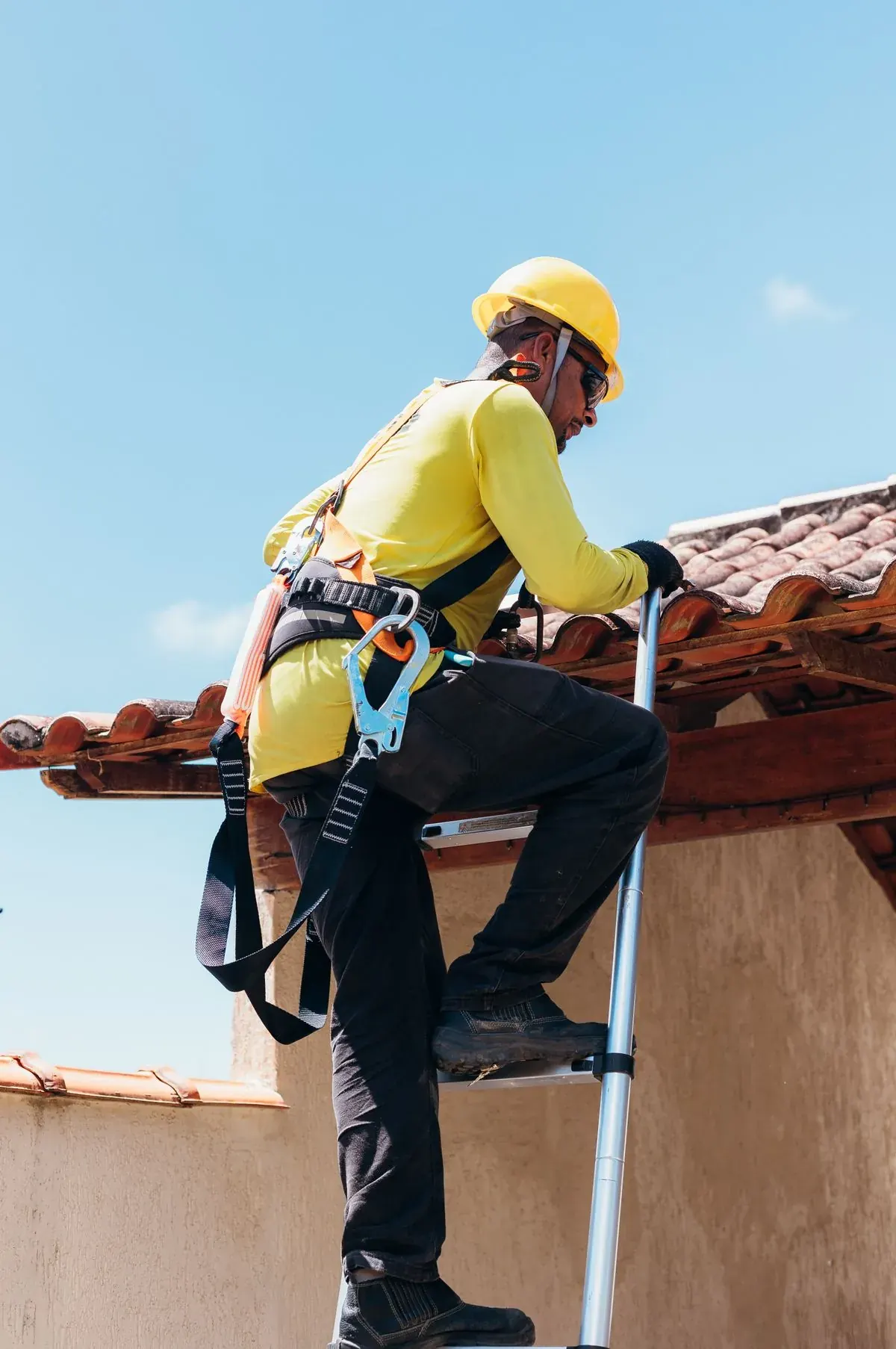
Buckeye's adopted code exempts a like-for-like residential re-roof from a building permit, but check before you rely on it. The City adopted the 2024 International Building Code and Residential Code, and its amendment to section 105.2 exempts residential re-roofing "with the same type of material as the original roofing", with no more than one layer of asphalt shingle laid over an existing shingle roof.
A change of material, structural work and commercial roofs are a different matter, and parcels in unincorporated Tonopah, Palo Verde and Arlington go through Maricopa County rather than the City. Read the permit guide.
Arizona roofing licenses
Roofing in Arizona is licensed work. The Registrar of Contractors issues R-42 for residential roofing, C-42 for commercial and CR-42 for both, and A.R.S. 32-1124 puts the license number, preceded by "ROC", on every written bid and estimate.
Ask for that number on any quote you get, and check it before you sign. How to check a license.
Monsoon roof damage
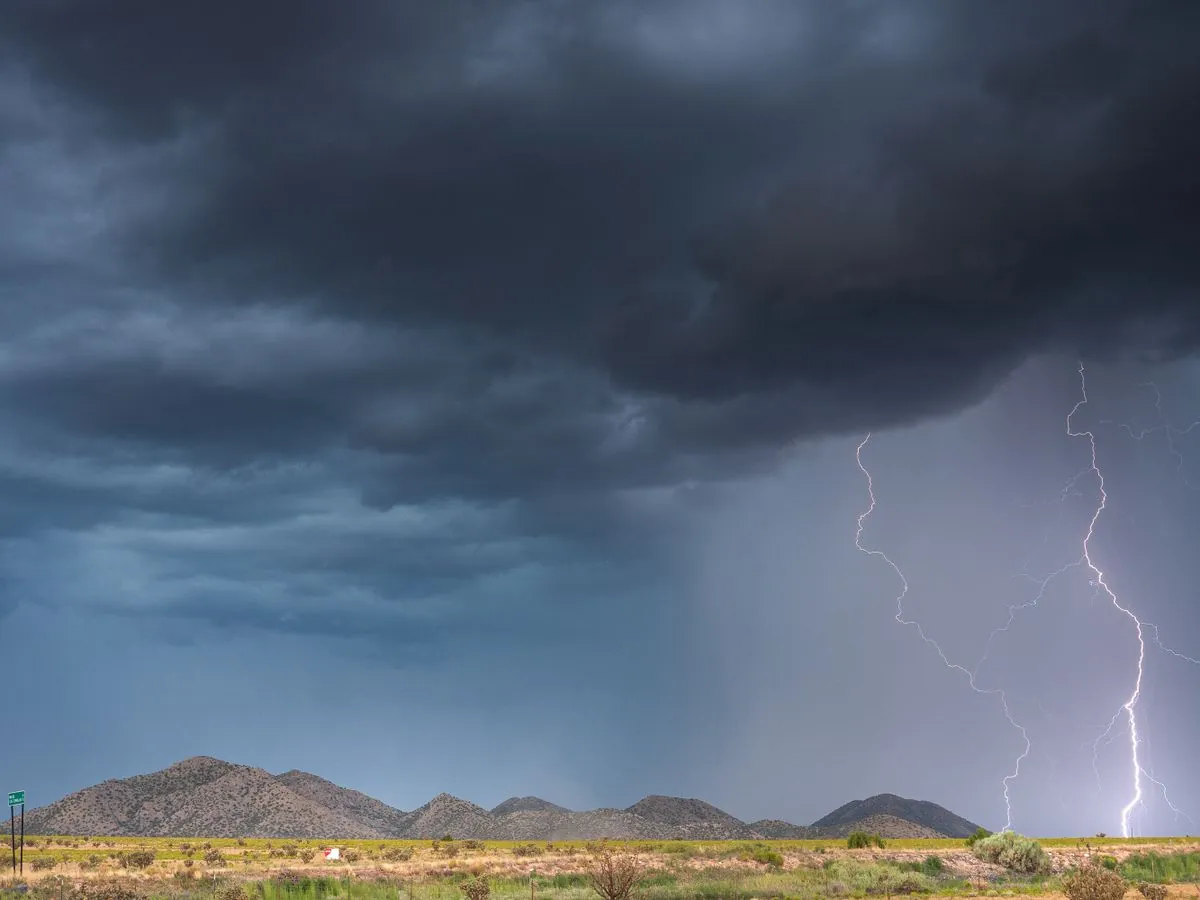
Monsoon damage to a Buckeye roof usually starts with wind, not rain. The National Weather Service defines the monsoon as June 15 through September 30. A severe thunderstorm warning is issued for damaging winds of 60 mph or greater, hail over an inch across is possible in the strongest storms, and a dust storm warning comes with gusts of 40 to 60 mph.
That wind lifts ridge and hip tile, slides field tile out of its course, peels back flashing and sandblasts foam coatings. The rain that follows finds every gap. A pre-monsoon inspection in May or June costs far less than a ceiling in August.
Roofing across all of Buckeye
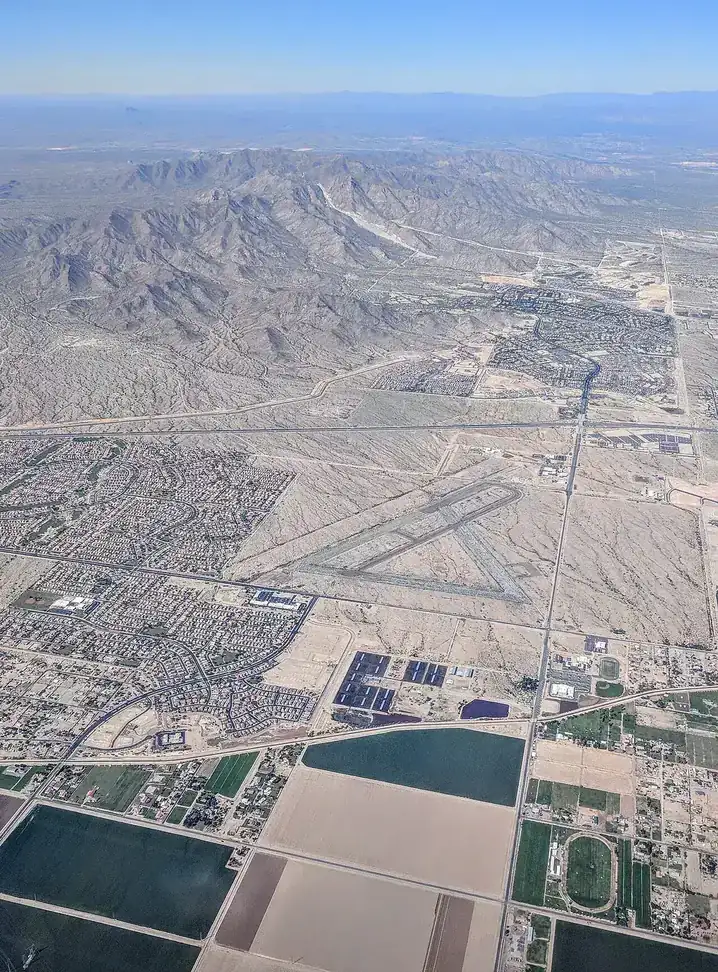
Buckeye covers 393 square miles about 30 miles west of downtown Phoenix, with Interstate 10 through its center, the White Tank Mountains to the north-east and the Gila River to the south. Roofers arranged through this site cover the whole city and the small unincorporated communities just beyond it.
- Roofing in Verrado→
- Roofing in Sun City Festival→
- Roofing in Festival Ranch→
- Roofing in Tartesso→
- Roofing in Sundance→
- Roofing in Historic Downtown Buckeye→
- Roofing in Tonopah→
- Roofing in Palo Verde & Arlington→
Buckeye roofing guides
Straight answers, with the sources named, to the questions Buckeye homeowners ask before they ask for a quote.
Roofing in Buckeye, AZ: frequently asked questions
How much does a new roof cost in Buckeye, AZ?
Most Arizona homeowners replacing a roof in 2026 pay between $9,000 and $28,000, and a typical 2,000 square foot Buckeye roof lands inside that range depending on material. Published 2026 Arizona figures put architectural shingle at $4.50 to $7.00 per square foot installed ($9,000 to $14,000 on 2,000 square feet), a tile underlayment replacement that reuses the existing tile at $4.50 to $8.50 ($9,000 to $17,000), a full new concrete tile system at $7.00 to $14.00 ($14,000 to $28,000) and spray foam at $3.50 to $7.00 ($7,000 to $14,000). The same guide adds $150 to $650 for a re-roof permit where one is needed.
My tile roof looks fine. Why is it leaking?
Because the tile was never the waterproof layer. On a concrete or clay tile roof, the underlayment beneath the tile is what keeps water out, and the tile mostly shades and protects it. Published Arizona service lives put single-layer 30-pound felt, the paper most Valley homes built before about 2005 received, at 15 to 20 years. Buckeye's big build waves started with Sundance in 2002, Verrado in 2004, Tartesso in 2005 and Sun City Festival in 2006, so a large share of the city's original felt is now at or past that age while the tile above it still looks good.
Do I need a permit to replace my roof in Buckeye?
Possibly not for a like-for-like re-roof on a house, and yes if anything else changes, but check first. Buckeye adopted the 2024 International Building Code and Residential Code, and its own amendment to section 105.2 exempts "Residential (R3) re-roofing with the same type of material as the original roofing", with at most one layer of asphalt shingle over an existing shingle roof. Switching material, for example shingle to tile or tile to foam, replacing structural decking, and commercial re-roofs fall outside that exemption. The City's Permit Center page also lists re-roofs among projects that require permits, so confirm with the Permit Center before work starts, and remember an HOA approval is a separate step.
How long does a roof last in Arizona?
It depends on which layer you mean. Concrete and clay tile commonly outlast the house's first owners, but the felt under it lasts 15 to 20 years in single-layer 30-pound form and 25 to 30 years as a double 40-pound layer, according to a Phoenix roofer's published Arizona table; synthetic underlayments run 25 to 40 years. Foam roofs can reach 30 to 50 years or more in the Valley if they are recoated about every 5 to 7 years. Asphalt shingle sits at the short end because the sun breaks it down fastest.
When is monsoon season and what does it do to a roof?
The National Weather Service defines the Southwest monsoon as June 15 through September 30. A severe thunderstorm warning means damaging winds of 60 mph or greater, and hail over an inch in diameter is possible in the strongest cells, while dust storms bring gusts of 40 to 60 mph. On a Buckeye roof that shows up as displaced or broken tile, lifted ridge and hip pieces, torn flashing and coating abrasion on foam, and then as leaks when the rain arrives behind the wind.
Is the roofer licensed?
Every quote that comes through this site is issued by a roofer licensed by the Arizona Registrar of Contractors. Arizona issues residential roofing licenses as R-42, commercial as C-42 and dual residential and commercial as CR-42, and A.R.S. 32-1124 requires the license number, preceded by "ROC", on all written bids and estimates. Check that number on the ROC website before you sign. Buckeye Roof Experts itself does not perform roofing work; it connects Buckeye property owners with a licensed roofer.
Should I repair or replace a 20-year-old roof in Buckeye?
On a 20-year-old tile roof with its original single-layer felt, a spot repair is usually buying time rather than fixing the problem, because the underlayment is at the end of its published 15 to 20 year Arizona life. That does not always mean a new roof: an underlayment replacement lifts and reuses the sound tile, and published Phoenix-area figures put it at $7,000 to $10,000 for a 2,000 square foot roof. A 20-year-old foam roof that has been recoated on schedule may have decades left; one that never has may need more than a coat.
About Buckeye Roof Experts
Buckeye Roof Experts is a Buckeye roofing service built around one idea: a homeowner should be able to get an honest, written roof quote from a licensed local roofer without being sold a new roof they do not need. We do not perform roofing work ourselves. Every estimate, contract and job comes from a roofer licensed by the Arizona Registrar of Contractors, with the ROC number printed on the bid.
More about us →Get a free roof quote in Buckeye, AZ
Four fields, no obligation. A licensed Arizona roofer looks at the roof and sends a written, itemized quote.
- An inspection on the roof, not a sales pitch from the driveway
- A written, itemized quote with the ROC license number printed on it
- Underlayment, flashing and deck condition called out, not just the surface
- Permit and HOA steps named in the quote when the job needs them