The short answer
How long a roof lasts in Arizona depends on the type, and for tile roofs, on the underlayment beneath the tile. The felt under tile lasts 15 to 20 years as single 30-pound felt, a well-maintained foam roof can reach 30 to 50 years or more with regular recoats, and asphalt shingle is the shortest-lived of the common roofs.
Arizona lifespans at a glance
| Roof or layer | Arizona service life | Source |
|---|---|---|
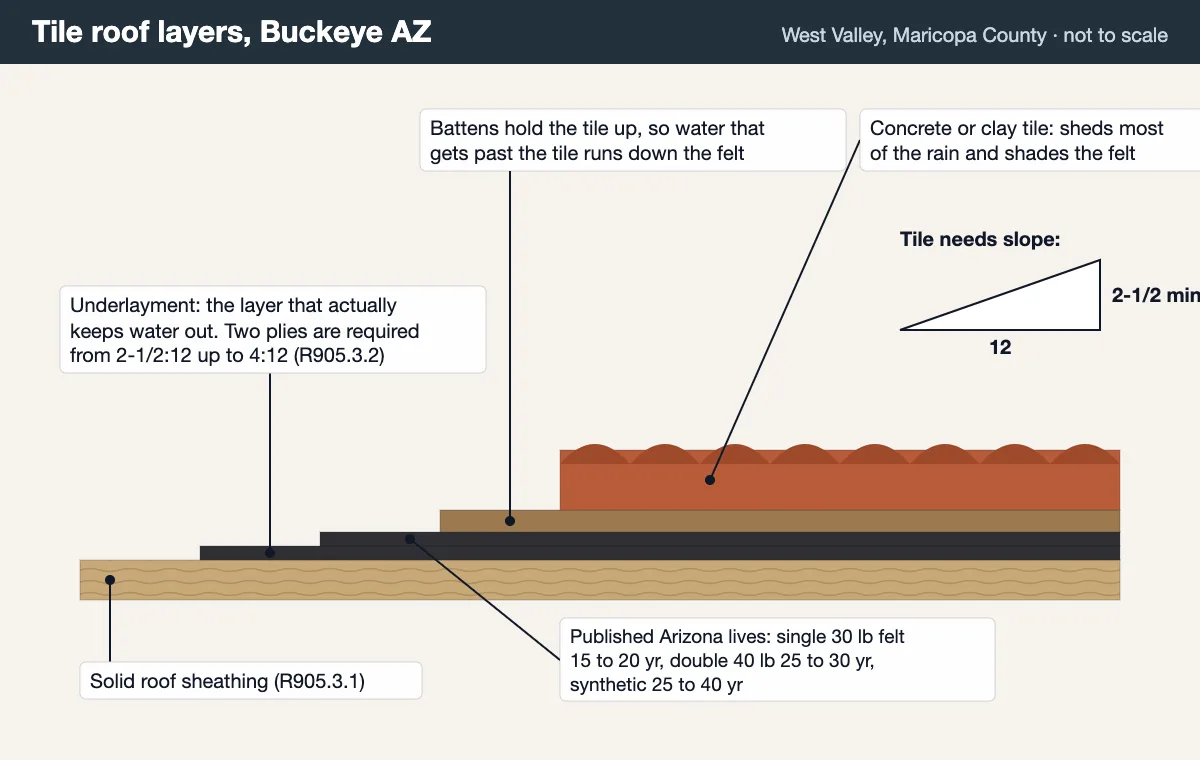
| Single 30# felt under tile | 15 to 20 years | Phoenix roofer's underlayment table |
| Double 40# felt under tile | 25 to 30 years | Phoenix roofer's underlayment table |
| G40 / modified underlayment | 25 to 35 years | Phoenix roofer's underlayment table |
| Synthetic underlayment | 25 to 40 years | Phoenix roofer's underlayment table |
| Peel-and-stick underlayment | 30 to 40 years | Phoenix roofer's underlayment table |
| Ordinary felt (alternative source) | About 12 to 20 years | Arizona roofing guide |
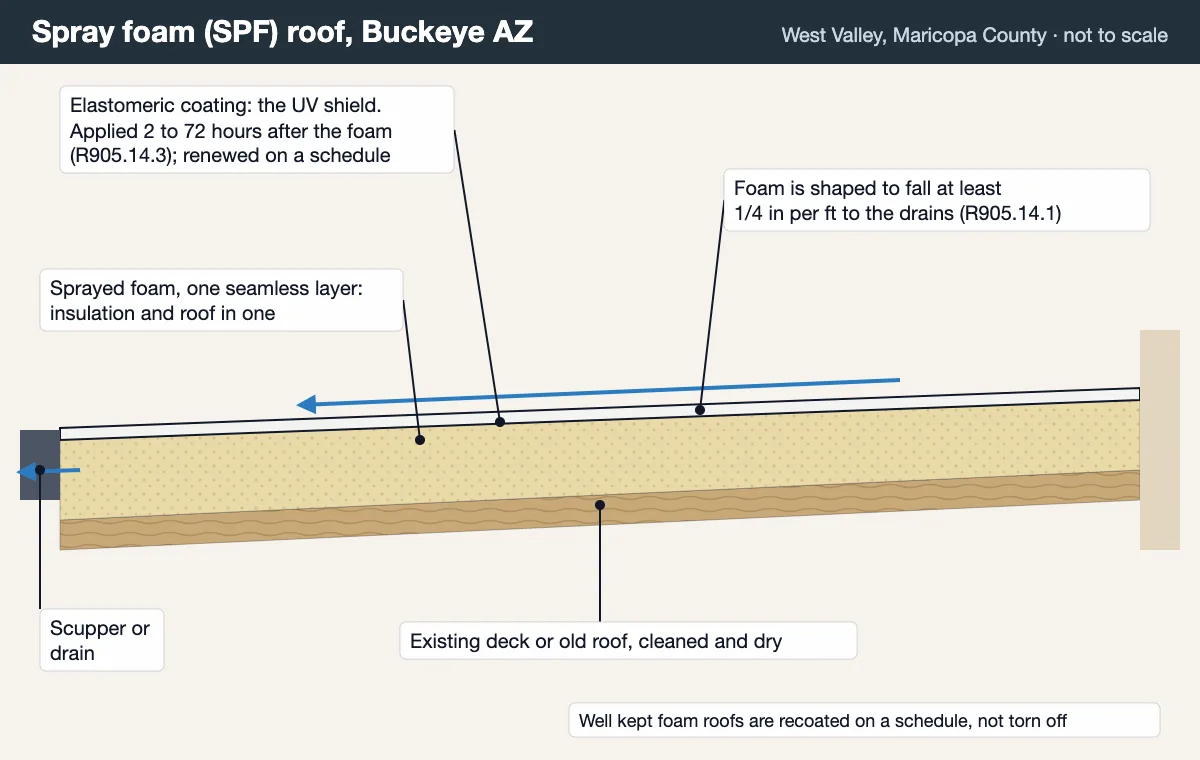
| Foam roof with recoats every 5 to 7 years | 30 to 50+ years | Phoenix roofer's foam guide |
| Well-maintained foam roof (alternative source) | 20 to 30+ years | Arizona roofing contractor |
Tile roofs: two answers
A tile roof has two lifespans. The tile itself lasts a very long time and is commonly lifted and relaid when the underlayment is replaced. The underlayment, which is the actual waterproofing, is what wears out, on the schedule in the table above.
That is why a tile roof that looks perfect from the street can leak. The tile is fine; the felt is not. A Phoenix roofer's table describes single 30-pound felt as "common on homes built before 2005", and notes that in the Phoenix metro, underlayment materials tend to age at the faster end of their ranges.
What that means in Buckeye
Buckeye built most of its tile homes from 2002 onward: Sundance from 2002, Verrado from 2004, Tartesso in the 2005 boom, Sun City Festival from 2006. Homes from those years on original single-layer felt are now at or past its published life. See tile roof underlayment replacement.
Foam roofs: as long as the coating lasts
A foam roof lasts as long as its coating is kept up. The coating is the sacrificial layer that takes the sun; a Phoenix roofer's guide says to plan on recoating about every 5 to 7 years in the Valley, noting that the 10 to 15 years quoted for moderate climates "is usually too optimistic" for Arizona.
| Approach | Typical outcome |
|---|---|
| Recoat every 5 to 7 years | Multiple recoats, no major tear-offs |
| Delay recoats to 10 to 12+ years | Foam exposed in places; repairs before recoating |
| Skip recoats | Foam erodes and takes on water; replacement |
Summarized from a Phoenix roofer's published foam maintenance guide.
Shingle, metal and membranes
Asphalt shingle
Shingle is the shortest-lived common roof in Arizona, because sun and heat are exactly what break asphalt down. The quality of the shingle line, a vented attic and a good underlayment make a real difference. See shingle roofing.
Metal
Metal is among the longest-lived roofs and avoids both the felt-under-tile and granule-loss problems. Exposed-fastener roofs need their screws and washers maintained; standing seam needs less. See metal roofing.
TPO and other membranes
Membrane life depends heavily on installation and detailing; seams, flashings and punctures cause most failures long before the sheet wears out. See TPO roofing.
Why Arizona is hard on roofs
- Heat: roof surfaces can pass 160 degrees in a Phoenix summer
- Duration: 2024 set a Phoenix record of 113 consecutive days at or above 100 degrees, beating 76 days set in 1993
- Thermal cycling: daily expansion and contraction works on fasteners, seams and coatings
- Ultraviolet light: breaks down asphalt, felt and coatings
- The monsoon: June 15 to September 30, with damaging wind, dust and heavy rain arriving together
Thinking about whether a 20-year-old roof should be replaced? Read should you replace a 20-year-old roof in Arizona.
Where Buckeye's roofs are in their life
Buckeye grew from 6,537 people in 2000 to 91,502 in 2020, and most of that growth came in tile-roofed master-planned communities. Set their build years against the published Arizona felt lifespans and a pattern appears.
| Community | Building began | Oldest roofs today | Where original felt sits |
|---|---|---|---|
| Sundance | 2002 | About 24 years | Past the published range |
| Verrado | 2004 | About 22 years | Past the published range |
| Tartesso | 2005 | About 21 years | Past the published range |
| Sun City Festival | 2006 | About 20 years | At the end of the range |
| Tartesso (restarted) | Late 2016 | About 10 years | Mid-life |
Build years from community records; felt lifespan from a Phoenix roofer's published Arizona table. Later phases in each community are younger.
Not every home in those communities has single 30-pound felt, and some have already been re-felted. That is why an inspection that lifts a few tiles is worth more than any table. See the community pages for Sundance, Verrado, Tartesso and Sun City Festival.
Signs a roof is nearing the end, by type
Tile
- Ceiling or attic stains after monsoon rain, with no broken tile visible
- Felt that is brittle, cracked or crumbling when a tile is lifted
- Tiles sliding out of line, or many cracked tiles
- Rusted or lifted flashing at walls, chimneys and valleys
Shingle
- Granules in gutters and at downspouts
- Curling edges, cracks across the tabs, or bare patches
- Missing tabs after wind
Foam and flat roofs
- Coating worn through, with tan or brown foam showing
- Blisters, soft spots or pitting in the foam
- Water standing after storms near drains and scuppers
- Seams opening on TPO or built-up roofs

What shortens a roof's life in Buckeye
The climate sets the baseline. These habits and events take years off it.
| Cause | What happens | What helps |
|---|---|---|
| Walking on tile | Cracked tile lets rain straight onto the felt | Only trades who know how to walk tile, on the right spots |
| New penetrations | Satellite, solar and vent installs open the roof | Flashing done by a roofer, inspected afterwards |
| Blocked valleys and drains | Water backs up under tile or ponds on flat roofs | Clear them before June 15 |
| Skipped foam recoats | Sun erodes the exposed foam | Recoat about every 5 to 7 years |
| Poor attic ventilation | Heat builds under the deck | Check intake and exhaust vents at the next re-roof |
| Slipped tile left in place | Each gap lets more water reach the felt | Reset slipped tile after every big storm |
Warranty is not the same as lifespan
A manufacturer's warranty describes what the manufacturer will cover, under its own conditions; it is not a promise of how long the product lasts on a Buckeye roof in July. A roofer's own warranty on workmanship covers the installation, usually for a shorter period. Ask for both in writing, and ask what voids them, such as missed maintenance or other trades cutting into the roof.
A maintenance plan that adds years
No maintenance plan stops the felt under tile from ageing, but it does stop small problems from shortening the roof's life. In the Phoenix area, the plan follows the seasons.
| Roof | Every year | On a cycle |
|---|---|---|
| Tile | Spring inspection; reset slipped tile; clear valleys | Re-felt when the underlayment reaches its life |
| Shingle | Check for lifted tabs and granule loss after storms | Replace at end of life |
| Foam | Inspect and repair damage before and after the monsoon | Recoat about every 5 to 7 years |
| Metal | Check fasteners, sealants and flashing | Replace washers and sealants as needed |
| TPO / membrane | Check seams, flashings and drains | Repair or recoat as the surface ages |
Keep a record of every visit: dates, photos and what was done. It helps the next roofer, supports warranty claims, and is useful evidence if you ever need to show an insurer that the roof was looked after.
Sources for this guide
- A Phoenix roofer's published Arizona underlayment lifespan table
- A Phoenix roofer's foam roof maintenance guide, and a second Arizona contractor's foam lifespan figures
- An Arizona roofing guide on material lifespans in Arizona's climate
- National Weather Service monsoon definitions and safety pages
- Local reporting of Phoenix's 2024 record of 113 straight days at or above 100 degrees
- Buckeye community build years from community and Census records
How to work out how long your roof has left
- Know your roof type. Tile, shingle, foam, metal or membrane, and on tile, the underlayment beneath it.
- Know its age. The build year or last re-roof date, from your records or the county assessor.
- Compare to Arizona lifespans. Use the published Arizona figures, not brochure figures from milder climates.
- Have it inspected. A roofer lifting tiles or checking coatings tells you where your roof actually is.
- Plan the next job. Budget for the re-felt, recoat or replacement before it becomes an emergency.