Shingle roofs in Buckeye
Shingle roofing in Buckeye, AZ is the budget-friendly pitched roof, used on older homes around the historic downtown, on some newer tract homes, on rentals, and on garages, casitas and outbuildings across the acreage parcels toward Tonopah and Palo Verde. Most of the master-planned communities went with concrete tile, so shingle is the minority roof here, but it is a common one.
Its strength is cost. A May 2026 Arizona cost guide puts architectural shingle at $4.50 to $7.00 per square foot installed, or $9,000 to $14,000 for a 2,000 square foot roof including tear-off, the lowest of any pitched roof. Its weakness is the sun: ultraviolet light and roof-surface heat are exactly what age asphalt shingle, and Buckeye gets plenty of both.
That makes the details matter more here than in milder places: a shingle line rated for heat, a real synthetic underlayment, proper flashing rather than reused metal, and an attic that is actually vented.
Shingle roof cost in Buckeye
A new shingle roof in Buckeye costs about $9,000 to $14,000 on a 2,000 square foot roof in architectural shingle. These published figures cover the realistic range.
| Source and product | Cost |
|---|---|
| Architectural shingle, tear-off and re-roof (Arizona 2026 guide) | $4.50 to $7.00 per sq ft; $9,000 to $14,000 on 2,000 sq ft |
| 3-tab shingle (Phoenix-area guide) | $3.50 to $5.50 per sq ft installed |
| Buckeye estimate, 1,282 sq ft shingle roof | $6,483 to $8,274 ($5 to $7 per sq ft) |
| Tear-off disposal (Phoenix-area guide) | $1.00 to $3.00 per sq ft |
Sources: Arizona roof replacement cost guide (May 2026), a Phoenix-area roof replacement cost guide, and a published Buckeye shingle roof cost estimate.
How desert sun ages shingle
Shingle ages in Buckeye from the top and the bottom at once. From the top, ultraviolet light breaks down the asphalt and loosens the mineral granules that protect it; that is why granules collect in gutters and at downspouts on older roofs. From the bottom, an attic that cannot shed heat cooks the shingle from beneath. Roof surfaces in a Phoenix summer can pass 160 degrees.
Signs a shingle roof is wearing out
- Granules collecting at downspouts and in gutters
- Shingle edges curling up or cupping on the south and west slopes
- Cracked or brittle tabs that break when lifted
- Bare, dark patches where the granule layer has gone
- Tabs missing or lifted after monsoon wind
- Daylight or water staining visible from the attic
Monsoon wind and shingle repair
Monsoon wind is the main cause of shingle repairs in Buckeye. The National Weather Service defines the season as June 15 through September 30, and severe thunderstorm warnings mean winds of 60 mph or greater. Those winds peel tabs back from the rake and ridge, tear pieces off and break the factory seal strips.
A shingle repair replaces the torn and missing pieces, reseals lifted tabs, and checks the underlayment beneath any exposed area. If a roof loses shingles in every storm, the seal strips have aged out and a replacement is better value than repeated repairs. See storm damage repair and roof repair.
Shingle, tile or metal?
Shingle makes sense in Buckeye where cost and speed matter most and the HOA allows it.
| Roof | Per sq ft | Best for |
|---|---|---|
| Architectural shingle | $4.50 to $7.00 | Budget, rentals, outbuildings, older homes |
| Tile-over (tile reused) | $4.50 to $8.50 | Existing tile roofs with failed felt |
| Concrete tile, new | $7.00 to $14.00 | Long-term owners, HOA communities |
| Metal | $8.00 to $18.00 | Acreage homes, shops, longest service |
Read tile vs shingle vs foam roofs in Arizona, see roof replacement and the service area, or request a shingle roof quote.
Attic ventilation: the hidden half of a shingle roof
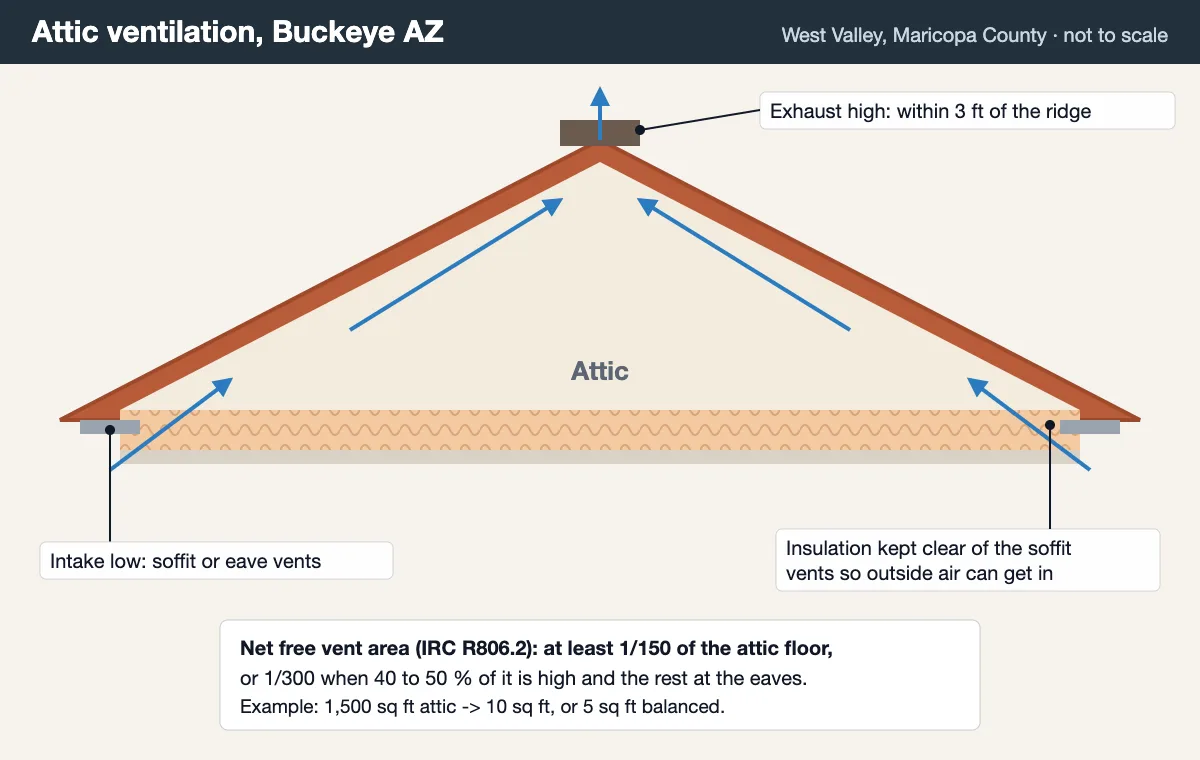
Attic ventilation is the part of a shingle roof most homeowners never see and most quotes barely mention. An attic needs air coming in low, at the eaves or soffits, and leaving high, at ridge or roof vents. When it cannot breathe, summer heat builds up under the deck and bakes the shingle from below at the same time the sun bakes it from above.
On a replacement, a roofer should check that the soffit vents are not blocked by insulation, that the exhaust vents are adequate for the attic size, and that the intake and exhaust are balanced. Fixing ventilation during a re-roof costs little compared with doing it later.
Where shingle roofs are found in Buckeye
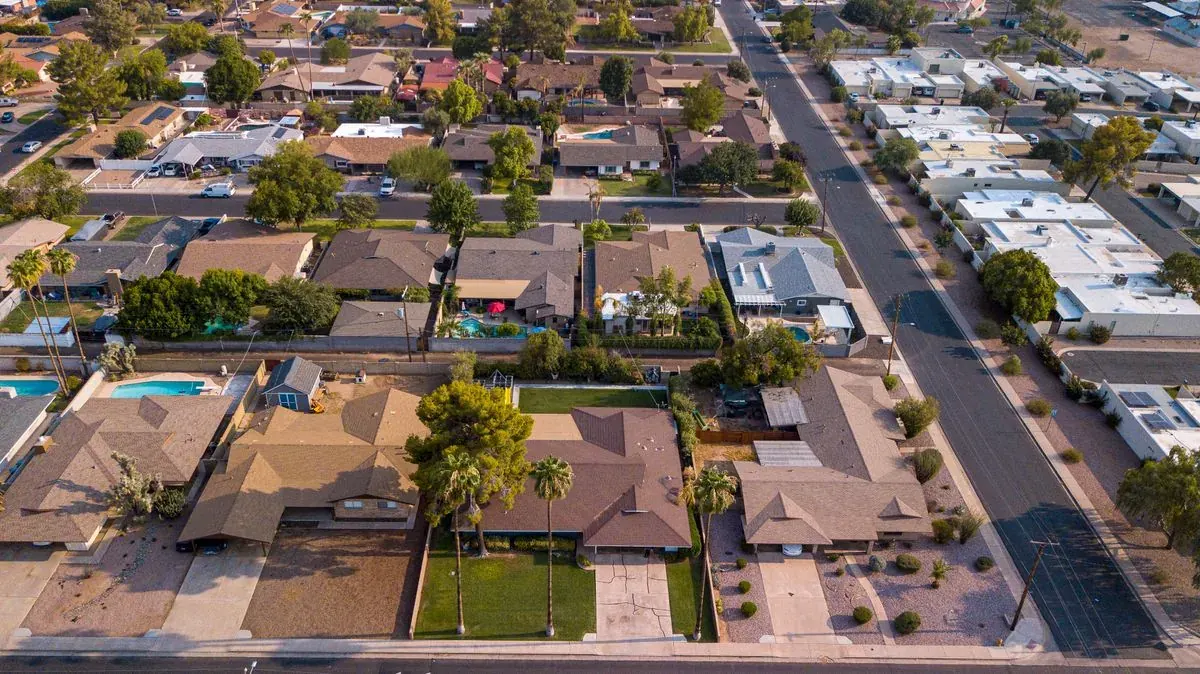
Shingle roofs are most common in three places around Buckeye: older homes near the historic downtown around Monroe Avenue, rural and acreage properties toward Tonopah, Palo Verde and Arlington, and outbuildings, garages and casitas everywhere. Some newer subdivisions use shingle too. The master-planned communities built from 2002 onward, Sundance, Verrado, Tartesso and Sun City Festival, went largely with concrete tile.
See roofing in historic downtown Buckeye and Palo Verde and Arlington.
Wind claims on shingle roofs
Shingle roofs are the roof type most often involved in monsoon wind claims, because missing and creased tabs are visible and clearly storm-related. Photograph the damage with dates before temporary repairs, collect any pieces that landed in the yard, and get the National Weather Service storm record for the date. Whether a claim covers a repair or a replacement depends on your policy and the extent of the damage. See roof insurance claims in Arizona.
How a shingle roof is installed
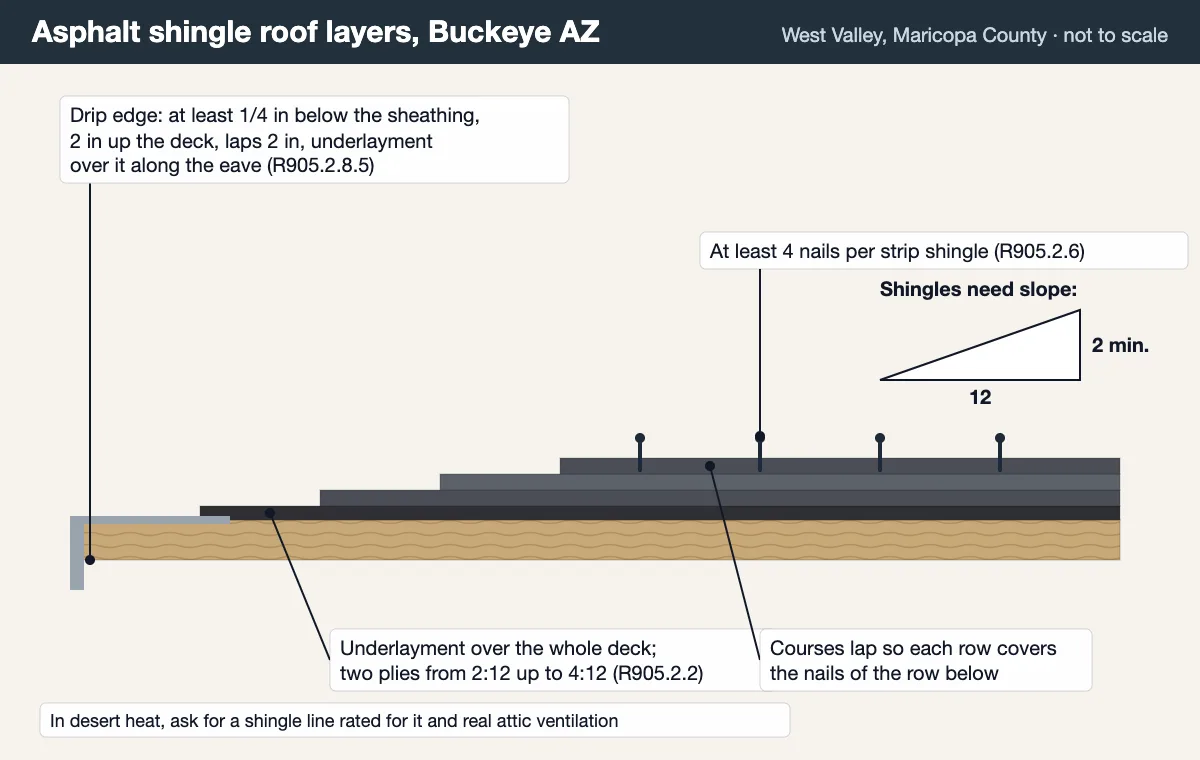
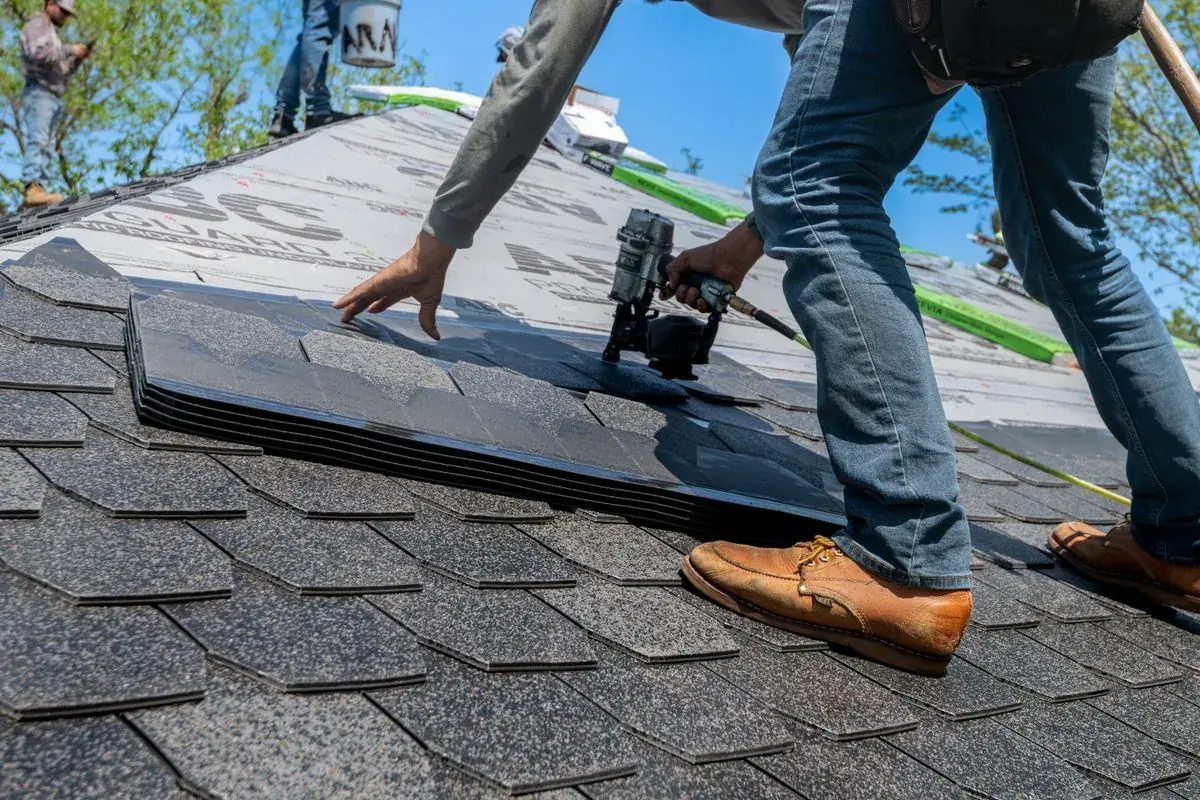
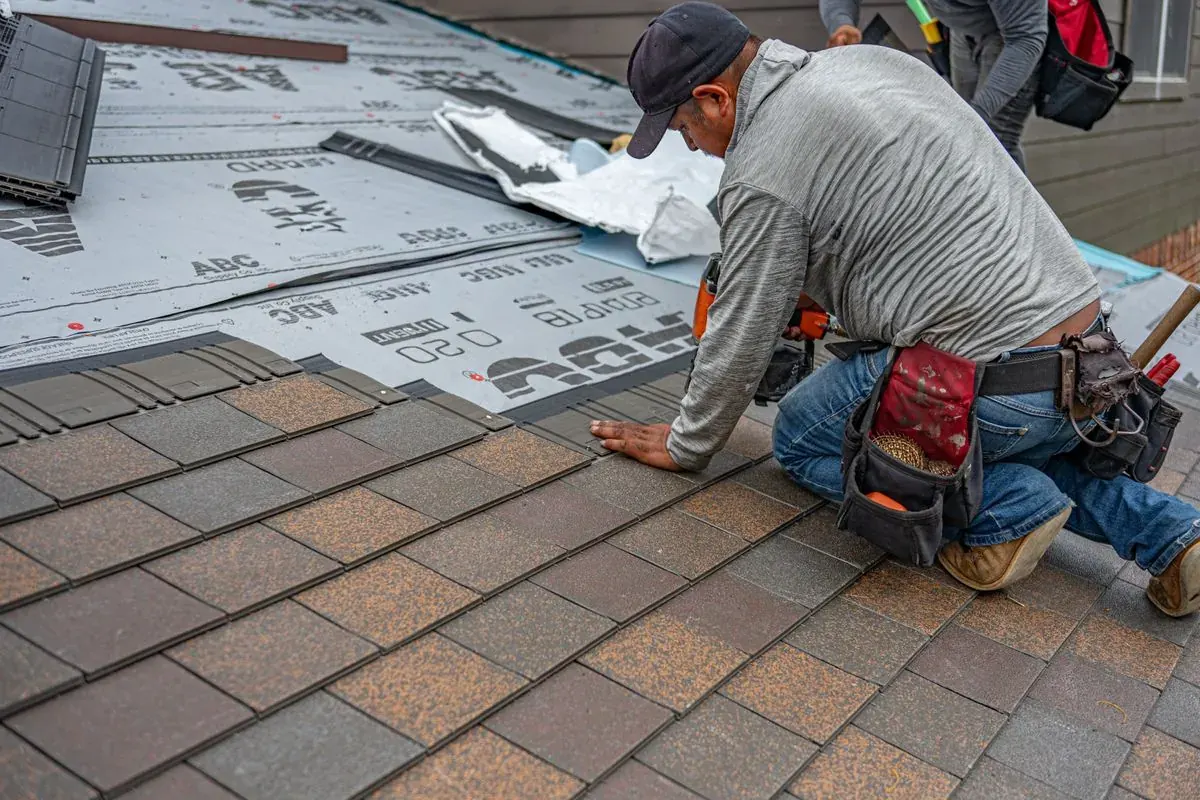
- Tear-off to the deck. Old shingle and underlayment are stripped so the deck can be inspected and damaged sheathing replaced.
- Ventilation check. Intake and exhaust ventilation is checked, because a hot, unvented attic shortens shingle life from underneath.
- Underlayment and edge metal. Synthetic underlayment, self-adhered membrane in valleys and at penetrations, and drip edge go down.
- Flashing. Step and counter flashing at walls, chimney flashing and new pipe boots are installed rather than reused.
- Shingle installation. Starter course, field shingle nailed to the manufacturer's pattern, and hip and ridge caps, with the seal strips allowed to bond in the heat.