What the monsoon does to Buckeye roofs
Storm damage to roofs in Buckeye, AZ is almost entirely a monsoon story. For most of the year the weather is dry and the roof sits untested. Then, from June 15 to September 30, the National Weather Service's defined monsoon season, thunderstorms build over the deserts and mountains and push outflow winds, dust and heavy rain across the West Valley.
The order matters for your roof. The wind comes first, lifting edges and displacing tile and shingle, and the rain follows minutes later through the gaps it just opened. That is why storm damage and the first leak so often arrive on the same afternoon.
Storm damage by roof type
| Roof | Wind | Hail | Dust |
|---|---|---|---|
| Concrete and clay tile | Ridge, hip and eave tile lifted; field tile slid out of course | Cracked tile in strong storms | Valleys and gutters filled, backing water up |
| Asphalt shingle | Tabs creased, torn or missing; seal strips broken | Bruising and granule loss | Granule abrasion, gutters filled |
| Spray foam | Coating damage from flying debris | Pocked coating | Coating sandblasted; drains blocked |
| Metal | Trims and edge panels lifted where under-fastened | Dents, usually still watertight | Gutters and valleys filled |
| TPO and membranes | Edge and perimeter peel; loose flashings | Punctures in severe hail | Drains and scuppers blocked |
Tile roofs
On tile, storm damage concentrates on the edges and high lines: ridges, hips, eaves and rakes. Displaced tile exposes the felt beneath, and on an older roof that felt may already be at the end of its life, which is where storm damage and wear become hard to separate. See tile roof repair.
Shingle roofs
Shingle shows wind damage most clearly: creased and missing tabs, often along one rake or ridge facing the storm. See shingle roofing.
Flat and foam roofs
Flat roofs collect debris and dust, their drains block, and the water has nowhere to go. Flying debris and hail damage coatings. See flat roof repair.

What to do after the storm
After a storm damages your roof, the order is safety, records, a temporary fix, then the claim and the permanent repair. Getting the records right in the first hour is what keeps a claim straightforward.
- Stay off the roof and away from any downed power lines; avoid the attic while lightning is active
- Photograph the roof from the ground and every interior stain, with dates, before anything is moved or tarped
- Keep any tile, shingle or metal that blew off, and photograph where it landed
- Write down the date and time the damage happened, so it can be matched to the National Weather Service record
- Have a licensed roofer make a temporary dry-in if the roof is open
- Report the damage to your insurer promptly, and keep a copy of everything you send
Storm chasers and doorstep contracts
After major Valley storms, out-of-area crews canvass neighborhoods offering inspections and quick replacements. Some are legitimate; some are not. The protection is simple and costs nothing: check the license.
Arizona requires roofing contractors to be licensed by the Registrar of Contractors, R-42 for residential and C-42 for commercial roofing, and A.R.S. 32-1124 requires the license number, preceded by "ROC", on every written bid and estimate. Look the number up before you sign anything, and do not sign on the doorstep. See how to check an Arizona roofer's license.
Getting ready before June 15
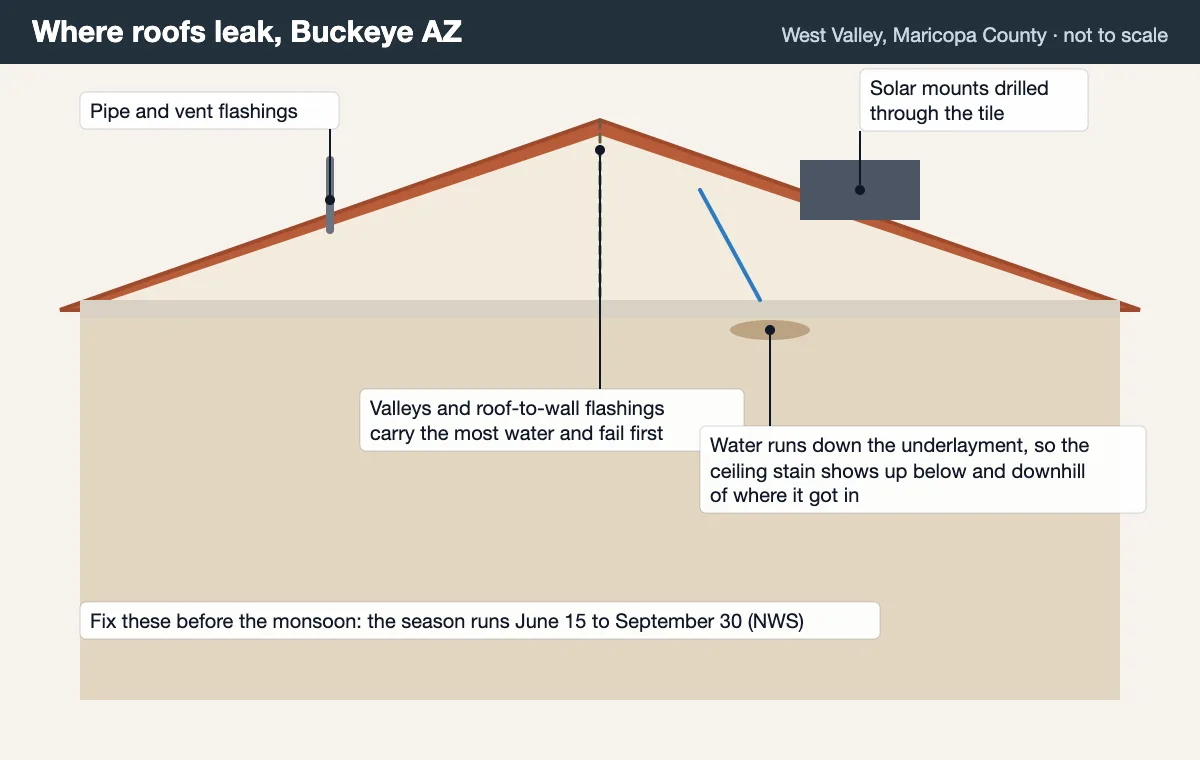
Most monsoon roof damage in Buckeye is made worse by something that was already loose. A spring inspection fixes those things while it is cheap.
- Reset and mechanically fasten loose ridge, hip, rake and eave tile
- Renew lifted or rusted flashing and split pipe boots
- Clear valleys, gutters, scuppers and roof drains
- Check foam coatings for wear-through and repair blisters
- Check metal trims and exposed fasteners
- Trim branches that overhang the roof
See roof maintenance, roof inspection, the monsoon roof damage guide, the service area, or request storm damage repair.

What a proper temporary dry-in looks like
A temporary dry-in after storm damage should keep water out until the permanent repair, without causing more damage. A tarp held down by a few bricks is not a dry-in; the next outflow wind takes it.
- The tarp extends over the ridge and well past the damaged area on every side
- It is secured with battens or weighted properly, not just a few loose bricks
- Displaced tile is reset by hand where it can be, rather than covered
- Nothing is nailed through sound tile or roofing
- Everything is photographed before and after
Assessing hail damage
Hail damage is less obvious than wind damage. On shingle it shows as bruises where granules have been knocked off and the mat beneath cracked; on tile as cracks and broken corners; on foam as pocks and punctures in the coating; and on metal as dents. Soft metals, such as vents and gutters, often show hail marks most clearly and help confirm that hail hit the roof.
National Weather Service warnings note that hail over an inch in diameter is possible with severe thunderstorms. If hail fell at your home, a roofer's written assessment with photographs is the evidence an adjuster needs.
After a storm: the process
- Make it safe and record it. Stay off the roof and away from downed lines. Photograph the roof from the ground and every inside stain, with dates, before anything is moved, and keep fallen tile or shingle.
- Temporary dry-in. A licensed roofer secures a tarp or resets displaced tile by hand to keep water out until the permanent repair.
- Storm damage inspection. The roofer documents what the storm did, separately from pre-existing wear, with photographs and a written description.
- Claim, if appropriate. Report to your insurer promptly with the photographs, the roofer's report and the National Weather Service record for the storm date.
- Permanent repair. Displaced tile is reset and fastened, broken pieces matched, flashing renewed, shingle replaced, or coatings repaired, with the underlying felt or foam checked.