What roof repair in Buckeye usually involves
Roof repair in Buckeye, AZ is mostly tile and flashing work, because concrete tile covers most of the city's homes. The common jobs are tiles that have slipped or cracked, ridge and hip pieces loosened by monsoon wind, flashings that have lifted at walls and chimneys, valleys blocked or worn through, and pipe and vent boots split by the sun. On flat sections the repairs are foam and coating damage, blisters and ponding.
Every one of those is fixable. What makes a repair worth paying for is that it addresses the cause, not just the spot where the water showed up. On a tile roof that means lifting tile and looking at the felt, because a leak below a perfect-looking tile is very often the felt itself.
And it means being honest when a repair is no longer the right buy. On a roof whose felt is 15 to 20 years old everywhere, fixing one leak only moves the next one. That is when an underlayment replacement or a roof replacement should be on the quote beside the repair.

The roof repairs Buckeye homes need most
Slipped, cracked and wind-displaced tile
Tile moves when it is walked on, when fasteners age and when monsoon downbursts get under the edges. A National Weather Service severe thunderstorm warning means winds of 60 mph or greater, and those winds lift eave, ridge and hip tile first. The repair is to reset or replace the tile and refasten it, and to check the felt in the gap it left. See tile roof repair.
Flashing at walls, chimneys, skylights and solar mounts
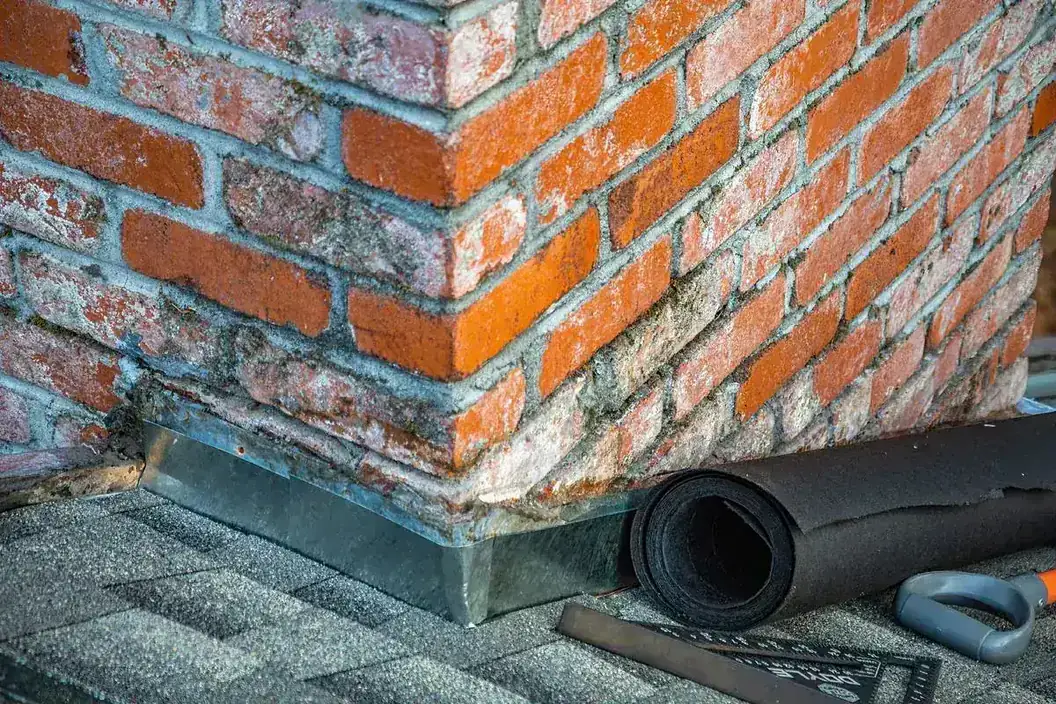
Flashing is the sheet metal that turns water where a roof meets a vertical surface or a penetration. It fails by lifting, rusting, separating from the wall or being sealed with mastic that has since cracked in the heat. Renewing it properly means removing the tile or shingle around it, not caulking over the top.
Valleys
Valleys carry the water from two slopes, so they fail early when debris builds up in them or the metal underneath has corroded. A valley repair on a tile roof usually means lifting the tile on both sides, renewing the valley metal and the underlayment beside it, and relaying.
Pipe and vent boots
The rubber collars around plumbing vents and the flashings around roof vents break down in desert sun, and a split boot lets water straight down the pipe into a wall. It is one of the cheapest leaks to fix and one of the most common.
Foam and flat roof damage
On spray foam, worn-through coating, blisters and bird-pecked holes let water into the foam; on membranes, split seams and punctures around rooftop equipment are the usual causes. See flat roof repair.
Shingle damage
Lifted and missing tabs after a wind event, nail pops, and granule loss on sun-facing slopes are the typical shingle repairs. See shingle roofing.
Repair or replace: how to tell
A roof is worth repairing when the covering and the layer beneath it are both broadly sound and the problem has one identifiable cause. It is worth replacing, or re-felting, when the failure is the layer itself.
| What the roofer finds | Usually the honest answer |
|---|---|
| One slipped or cracked tile, felt sound elsewhere | Repair |
| Failed flashing or pipe boot on a young roof | Repair |
| Felt brittle across several slopes, tile sound | Underlayment replacement |
| Leaks in several places over one or two seasons | Underlayment replacement or replacement |
| Shingles cracking and shedding granules across slopes | Replacement |
| Foam coating worn but foam sound | Recoat |
| Foam eroded, wet or blistered over wide areas | Foam repair or replacement |
A guide, not a rule: the deck, the roof's age and your plans for the house all feed the decision. Ask for the options priced side by side.
There is a longer answer in should you replace a 20-year-old roof in Arizona.
About the "25 percent rule"
The "25 percent rule" does not apply to roof repairs in Buckeye. It is a Florida Building Code concept, and it shows up constantly in searches about roof repair, so it is worth clearing up.
Buckeye's October 2024 code update adopts the 2024 International Building Code and Residential Code with City amendments, and none of those amendments create a percentage trigger for roof repairs. What does apply is the City's exemption for like-for-like residential re-roofing, plus whatever your HOA's architectural rules say about materials and color. The details are in the 25% rule and Arizona.
Repairs before the monsoon
The cheapest time to repair a Buckeye roof is before June 15, when the National Weather Service's monsoon season starts. A loose ridge tile or a lifted flashing in May is a small job; the same defect after a downburst and a night of rain is a ceiling, insulation and sometimes a claim.
- Clear valleys, gutters and roof drains of the debris that dust storms leave behind
- Reset and refasten loose ridge, hip and eave tile
- Renew cracked pipe boots and resealed vent flashings
- Check flat-section coatings for wear-through and blisters
- Confirm solar mounts are flashed, not just sealed
- Look in the attic for old stains and daylight
See roof maintenance, storm damage repair, the service area, or request a repair quote.
How a proper repair is done
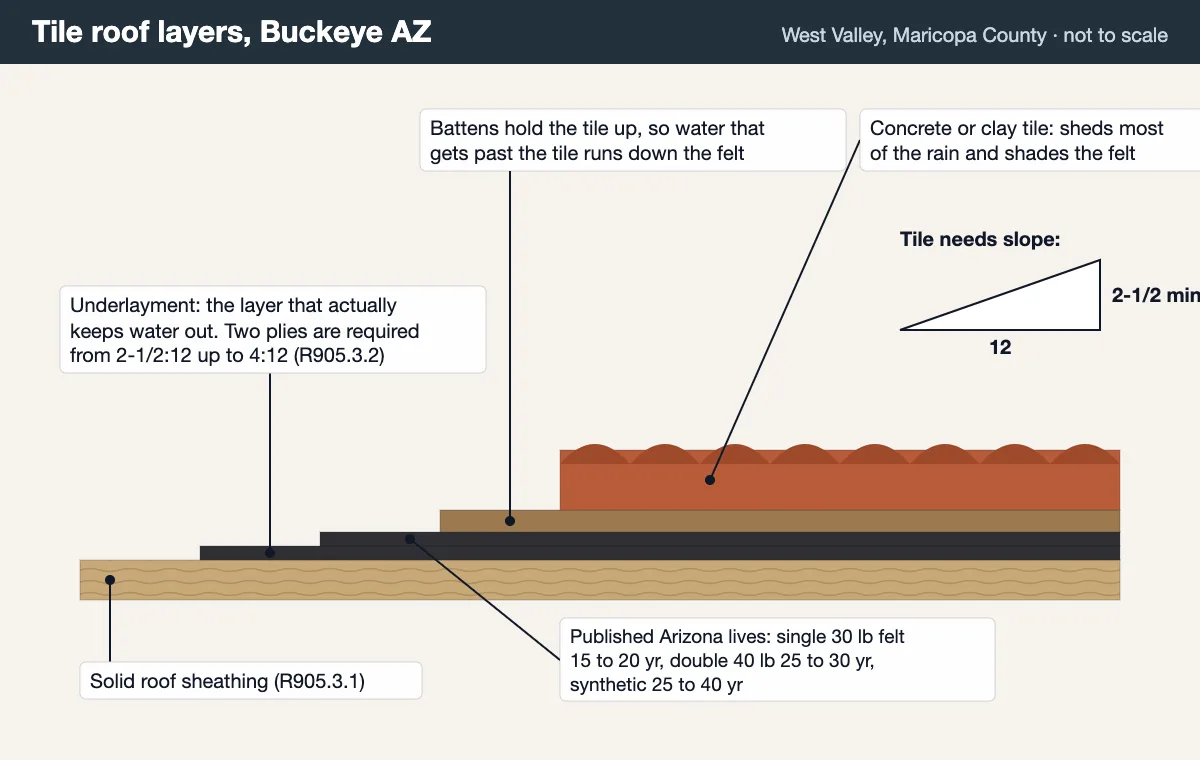
- Find the real entry point. Water travels along felt, battens and rafters before it shows on a ceiling, so the roofer works uphill from the stain, lifting tiles or checking seams, until the actual opening is found.
- Check the layer underneath. Before fixing the surface, the roofer looks at the felt, membrane or foam beneath it. If that layer has failed, the quote should say so rather than selling a patch.
- Quote the cause, not the symptom. The written quote names what failed, why, and the fix, with options where there is an honest choice between repair and a larger job.
- Repair with matching materials. Tile is reset or replaced with a matched piece, flashing is renewed rather than caulked over, foam is cut out and refilled, and membranes are patched with compatible material.
- Photograph and water-check. You get photos of the cause and the repair. Where it is practical, the repaired area is water-tested before the job is signed off.